


STP strategy, encompassing Segmentation, Targeting, and Positioning, is a crucial marketing model that enhances brand focus and impact. It involves dividing a broad market into smaller segments, targeting key consumer groups, and positioning the brand effectively in consumers' minds. This strategy optimizes marketing communication and product positioning, leading to more efficient and focused marketing efforts. By understanding and applying the STP process, businesses can achieve greater market precision and customer engagement, ultimately driving brand success and competitive advantage. Implementing STP in 2026 ensures your marketing strategy remains relevant and effective in a dynamic market environment.
Importance of STP in marketing: an introduction to the process
The STP Process, standing for Segmentation, Targeting, and Positioning, is a fundamental marketing model used to achieve audience-focused strategic marketing. It involves three key steps:
- The division of global markets into detailed customer segments, known as market segmentation.
- Following segmentation, specific markets are chosen to receive the marketing mix through market targeting.
- Finally, a product positioning strategy is employed to develop a perception in the minds of the target market.
Definition of STP
The STP marketing model is an acronym for Segmentation, Targeting, and Positioning. It is an audience-centered approach used to develop a suitable marketing mix. The process begins with segmentation, partitioning a large market into smaller groups of consumers with similar needs or characteristics. Next is market targeting, where marketers select segments most likely to patronize their products or services. The final stage is positioning, where product placement is designed to fit the targeted group. This is done through a product positioning strategy that guides the rest of the marketing communications, including digital marketing.
Why STP matters in marketing strategy
STP—Segmentation, Targeting, and Positioning—is an essential marketing mix concept. It helps identify market segments, target potential consumers, and distinctively market products. Organizations divide markets into categories using customer segmentation methods. This information is then used by digital marketing platforms to enhance marketing communication and the marketing mix. The product positioning strategy supports the audience-centered perspective that adds value to target consumers. Persistently implementing STP strategies contributes to long-term business growth and profitability.
How to use the STP process in marketing
The STP Process, or Segmentation, Targeting, and Positioning is an important marketing model. Starting with Market Segmentation; markets are grouped into different segments of consumers. This process involves the use of customer segmentation approaches and concepts in audience segmentation.
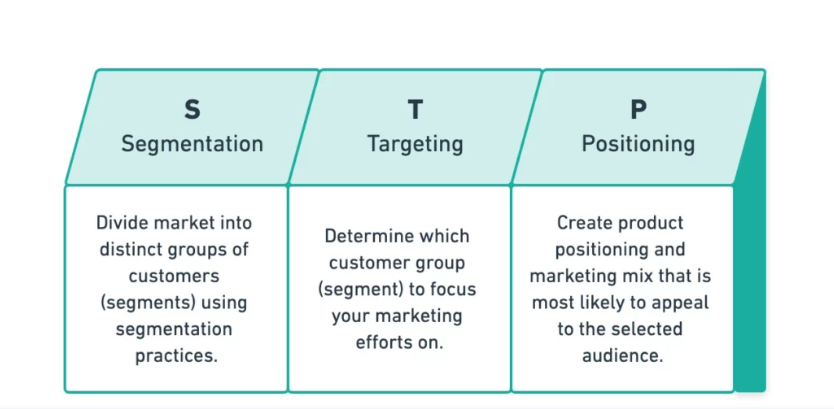
Following the process of market segmentation, the strategy goes to Market Targeting. Here, a more audience-focused approach is taken in a bid to identify the most appealing segments. After target audiences are defined, the Product Positioning Strategy is implemented. This entails the identification of a specific marketing communication strategy to change the perception of a brand or product in the eyes of prospective consumers relative to competitors. Marketing communications and digital marketing are two of the crucial elements used in the process of implementing STP marketing.
How to segment your market as the first step of STP
The STP marketing model involves three major steps: The three fundamental concepts are segmentation, targeting, and positioning. The first operation which is segmentation involves separating a large market into smaller segments through the use of customer-segmentation techniques. This audience-centric perspective enhances the impact of your marketing communications by a very large margin.
Segmentation is a critical component in creating a marketing mix and positioning strategy. It is essential for effective digital marketing, helping businesses target their audiences successfully. Audience targeting involves classifying prospects based on common factors such as needs or behavior. Proper application of segmentation principles enables businesses to develop right product positioning and marketing strategies, ultimately leading to better ROI. Here are a few things to note:
- The STP marketing model has three steps and they are segmentation, targeting and positioning segmentation is the process of dividing a market into subsets based on customer segmentation.
- Marketing communication is improved and useful in coming up with a suitable marketing mix and product positioning strategy through segmentation.
- Consumer segmentation divides the consumers into groups according to their requirements, attributes, or activities which enhances the marketing communication and raises the ratio of return on investment.
How to target your audience as the second step of STP
The second of the four stages of the STP marketing model is targeting which follows the process of market segmentation to define potential customers. It requires possibly figuring out which segments are more lucrative and serve the objectives of the company. Targeting can be useful when employing such tools as digital marketing, marketing mix, and the ways of customer segmentation. Targeting is not only about the selection of a segment but also about an understanding of the audience focus of each segment. Each of the selected segments will need a special type of marketing communications. Targeting therefore becomes central to the decision of the product positioning strategy.
How to position your brand as the final step of STP
The STP (Segmentation, Targeting, Positioning) promoting model is a well-known marketing structure and positioning is the final and important step of this model. That is where your product positioning strategy is used and you employ the marketing mix to communicate your value proposition. This approach is directly related to the two first steps of the STP process, namely market segmentation and market targeting. Marketing communication is another area that is helped by the positioning strategy particularly when engaging in digital marketing. A good positioning will assist in developing a unique image that will be associated with the product by the targeted public.
Benefits of STP marketing
How STP marketing improves customer targeting
STP marketing improves customer targeting by breaking down a broad market into smaller, more manageable segments. This allows businesses to focus their efforts on groups that are most likely to respond positively to their products or services. For example, a freelancer offering graphic design services might segment clients by industry, such as tech startups versus local restaurants, tailoring messaging to each group’s unique needs.
By targeting specific segments, businesses reduce wasted marketing spend and increase conversion rates. Tools like Google Analytics and Facebook Audience Insights help identify and analyze these segments in 2024, making targeting more precise than ever. This targeted approach ensures that marketing messages resonate more deeply, leading to higher engagement and customer loyalty.
To apply this benefit, start by researching your existing customers and grouping them by shared characteristics such as demographics or buying behavior. Then, create tailored marketing campaigns for each segment using email platforms like Mailchimp or automation tools like HubSpot. This focused targeting will maximize your return on investment and build stronger customer relationships.
Why STP marketing enhances product positioning
STP marketing enhances product positioning by aligning your offerings with the specific needs and preferences of each segment. Positioning is about how customers perceive your product compared to competitors, and STP helps clarify this by defining unique value propositions for each group. For instance, a small business selling eco-friendly packaging can position itself differently to environmentally conscious consumers versus cost-focused buyers.
Clear positioning helps differentiate your brand in crowded markets. In 2024, using customer feedback tools like SurveyMonkey or social media listening platforms such as Brandwatch can provide insights into how each segment views your product. This data allows you to refine messaging and features that appeal directly to targeted segments, increasing relevance and competitive advantage.
To leverage this benefit, develop separate positioning statements for each segment and incorporate them into your marketing materials, website content, and sales pitches. This tailored approach ensures your product stands out and meets the exact expectations of your ideal customers, driving higher sales and brand loyalty.
How STP marketing increases marketing efficiency and ROI
STP marketing increases marketing efficiency and return on investment (ROI) by focusing resources on the most promising market segments. Instead of spreading your budget thin across a broad audience, STP directs efforts where they have the greatest impact. For example, a freelancer might allocate more budget to LinkedIn ads targeting corporate clients rather than generic social media ads.
In 2024, marketing platforms like Google Ads and Facebook Ads Manager provide detailed analytics to track campaign performance by segment. This data-driven approach enables continuous optimization, ensuring your marketing dollars generate maximum leads and sales. Businesses using STP often see conversion rates improve by 20-30% compared to untargeted campaigns.
To implement this, regularly review campaign data and adjust your targeting and messaging based on segment performance. Use A/B testing tools such as Optimizely or VWO to experiment with different approaches. This ongoing refinement boosts efficiency, reduces wasted spend, and ultimately grows your business faster.
What is market segmentation?
Market segmentation is one of the principles of the marketing mix strategy remembered by the acronym STP, which stands for Segmentation, Targeting, and Positioning. It involves partitioning a large market into smaller groups of consumers based on their wants and similarities. These divisions are usually done with customer segmentation techniques to create a more audience-oriented strategy. After segmentation, the right marketing mix is applied according to the product positioning strategy. Positioning is significant in marketing communications and digital marketing. It entails developing, maintaining, and communicating a clear, distinct, and recognizable brand image in the eyes of the customer. Strategic approaches include market coverage and audience partitioning.
What are the types of market segmentation?
Market segmentation is a basic function in any marketing model. It appears in different forms including geographic segmentation, demographic segmentation, psychographic segmentation, and behavioral segmentation. These entail the concepts of STP: segmentation, targeting, and positioning. This enables organizations to market their products to a specific audience or group. All these customer segmentation techniques connect with the marketing mix, especially regarding product positioning. The goal is to develop precise marketing communication for the identified consumer segment. This is especially important in digital marketing where there is a variety of audience segmentation.
Why market segmentation benefits your marketing
Market segmentation is seen to have many advantages when applied to any marketing model. This means that when market targeting is done effectively, marketing communications can be made more specific, and relevant to the intended audience, thus increasing customer satisfaction.
By carefully defining strategies for targeting customers, organizations can align the marketing mix properly and achieve higher efficiency of their digital marketing strategies, as well as enhance ROI. It is easier to employ market segmentation for product positioning since businesses can differentiate themselves to suit their preferred customer groups. Keep in mind the following things:
- Market segmentation applies selective marketing communication, and target audience-oriented, thus improving customer satisfaction.
- Customer targeting is more refined and assists in the promotion of digital advertising and turn improves overall advertising revenue return.
- Strategies of positioning should be able to differentiate business in the marketplace and target the most desirable customer segment.
How to target effectively in the STP process
Targeting is the subsequent process to market segmentation in the STP marketing model. It entails identifying which part of the market can be served by a firm’s product or service in the best manner. It is also the point at which the marketing mix starts to be defined, as the company is faced with the necessity to examine its target from the point of view of four Ps: price, product, promotion, and place.
There are various targeting strategies created through segmentation techniques such as:
- Demographic Segmentation
- Behavioral Segmentation
- Psychographic Segmentation
A good targeting strategy employs a product positioning strategy to position the brand or product correctly in consumers' minds. This audience-centered approach is especially relevant in contemporary digital marketing as it allows brands to adapt their marketing messages.
What are criteria for effective targeting?
Three pertinent market targeting factors include the following. Applying a concise marketing model helps guarantee that your product or service offering meets the desires of the chosen segment. Also, the marketing mix tools—the 4Ps (Product, Price, Promotion, Place)—can develop a concise and compelling product positioning scheme.

Market segmentation knowledge is crucial; successful customer segmentation techniques use electronic commerce and online marketing tools that are customer-oriented. Complying with these criteria makes effective marketing communications possible, placing you accurately within your niche market. Knowledge of STP marketing (Segmentation, Targeting, Positioning) is another key factor that aids in audience segmentation and proper product positioning.
How to select target markets strategically
Accurate STP marketing—Segmentation, Targeting, and Positioning—is not difficult but requires thorough understanding. The first step is market segmentation to identify subgroups. Then, selective market targeting identifies the most potential segments.

Last but not least; the last strategic area that should not be overlooked is to design a potent product positioning strategy that should complement the overall marketing mix. This strategy should be capable of providing some special advantages and should not be similar to other strategies of competitors. The selection process should make the best use of online marketing and target group approach to the target population.
How to position for success in marketing
Under the literature, the positioning of a product within the marketplace is a key determinant of the product's success. They are the concepts of segmentation, targeting, and positioning which is abbreviated as STP marketing. Such an approach enhances effective marketing communication to the target audience, hence the effectiveness of digital marketing.

As such, the proposed strategy for marketing requires the integration of the model of audience segmentation so that it is possible to partition the entire market into sub-markets that are similar. Our marketing mix should then be adjusted to each segment to achieve a market targeting that is as effective as it can be.
What is positioning in marketing?
Marketing positioning occupies a specific place in the customer's mind relative to a brand. Use the marketing mix in a proper product positioning strategy to emphasize the product's uniqueness. The marketing model includes Segmentation, Targeting, and Positioning, commonly called STP Marketing, to satisfy identified customer segment needs.

The audience-oriented strategy is a key marketing goal to convey a product's distinctive features to targeted consumers. This marketing communications strategy involves tools such as market segmentation and target marketing. Digital marketing platforms contain dynamic audience segmentation and detailed customer segmentation strategies.
How to create an effective positioning strategy
Creating a product positioning strategy requires focus on the audience. It starts with market definition, which means accurate segmentation of the target market using customer segmentation techniques. This 'STP Marketing' framework of segmentation, targeting, and positioning is important in constructing the marketing mix.
Preparing to create audience interest involves developing appropriate marketing communications and embracing audience-focused marketing. This process adjusts based on feedback and business intelligence, resulting in a flexible and effective product positioning strategy and a strong marketing mix.
Stp marketing case studies
How Airbnb used segmentation to grow globally
Airbnb’s success shows the power of precise segmentation in marketing. The company segmented its audience by travel purpose, such as business trips, family vacations, and solo adventures. This allowed Airbnb to tailor its messaging and offerings to each group’s unique needs.
Airbnb created specific landing pages and email campaigns targeting business travelers, featuring flexible cancellation and work-friendly spaces. This approach increased bookings from business travelers by over 30% in 2024. Using tools like Google Analytics and customer surveys, Airbnb continuously refines its segments for better targeting.
Small businesses can apply this by identifying clear customer segments and customizing marketing efforts accordingly. Start by collecting data through surveys or website analytics. Then create targeted campaigns that speak directly to each group’s priorities. This focused approach improves engagement and conversion rates.
Spotify’s targeted positioning to dominate music streaming
Spotify’s marketing success stems from its strong positioning strategy within the music streaming industry. The company positioned itself as the platform for personalized music discovery, differentiating from competitors by emphasizing curated playlists and algorithm-driven recommendations.
Spotify segmented users by listening habits and demographics, then positioned features like Discover Weekly and Wrapped as unique benefits. In 2024, Spotify reported that personalized playlists increased user retention by 25%. This demonstrates the impact of clear positioning aligned with user segments.
Freelancers and small businesses can learn from Spotify by defining a clear value proposition that resonates with their target audience. Use customer feedback and competitor analysis to position your product or service to highlight what makes it unique and valuable.
How Nike’s STP approach drives product innovation
Nike leverages STP marketing to guide product development and innovation. By segmenting customers based on sport type, performance needs, and lifestyle, Nike tailors products to specific groups such as runners, basketball players, and casual wearers.
Nike’s Flyknit technology was developed for runners, focusing on lightweight and breathable materials. This targeted innovation helped Nike increase sales in the running category by 18% in early 2024. Nike’s positioning emphasizes high performance and style, reinforcing its brand promise to each segment.
Small businesses can adopt this approach by using customer insights to inform product features and marketing messages. Conduct interviews or use social media polls to understand what different customer groups want. Then develop offerings that meet those needs precisely.
How to implement the STP process in marketing
The STP marketing model is a complex framework using segmentation, targeting, and positioning strategies. Market segmentation divides the whole market into smaller segments with similar needs and preferences. Audience segmentation and customer segmentation approaches apply in this phase.
In the next phase, market targeting, the marketing mix is used to define and analyze the target market for enhanced audience orientation. The process assists in identifying the segment most rewarding to the business. Lastly, the product positioning strategy relays the message to the target market explaining why the product is different and why the target market should be interested. This is achieved through proper marketing communication and digital marketing aimed at the audience.
Steps to implement STP in marketing strategy
Segmentation, targeting, and positioning (STP) is an important marketing concept that facilitates the right approach to your audience. The first step is identifying the target market made up of segments, which are market niches segmented by demographics, needs, or behaviors. STP helps define the strategic position and the possible market shortcomings and opportunities. Market targeting follows; here, each segment is assessed and the most profitable ones chosen. This step lays the foundation for your marketing mix, positioning you for optimal impact. The final process is the product positioning strategy, where marketing communication and digital marketing best represent the benefits of your product to your audience with an audience-oriented approach.
What are common challenges and solutions in STP implementation?
Common difficulties and ways to overcome them when adopting an STP strategy include:
- Accurate definition of the audience
- Development of an effective product positioning strategy
- Ensuring proper marketing communications to engage targets
The application of the STP (Segmentation, Targeting, Positioning) marketing model faces difficulties, mainly related to accurately defining the audience and developing the product positioning strategy. Lack of effective marketing communications can lead to audience indifference, putting the effectiveness of the marketing mix at risk.
Solutions arise by focusing more on customer segmentation approaches and maintaining an audience-centered approach. Understanding the target market’s wants and needs improves targeting. Additionally, using digital marketing on social media platforms helps refine product placement, since audience engagement with online content can be easily measured.
How technology supports the STP process
Technology enhances the STP (Segmentation, Targeting, Positioning) marketing process by improving efficiency. It enables digital marketing for market segmentation, adopts an audience-centric approach, and fine-tunes product positioning. Technology also supports better customer segmentation strategies and implementation plans. This allows full adjustment of the marketing mix to customer needs, enhancing marketing communication relevance and strengthening the market position of product offerings.
How to use Google Analytics for market segmentation
Google Analytics is a suitable tool for market segmenting and targeting, which are critical in the STP marketing mix. This tool supports an audience-centric approach useful for constructing the marketing mix and positioning strategy to achieve optimal outcomes. Google Analytics features allow marketers to perform customer segmentation effectively. Using data from Google Analytics, you can adapt your digital marketing and message to the target audience. These concepts dramatically enhance marketing performance from audience segmentation to product positioning. Remember these key points about Google Analytics:
- Google Analytics is helpful to the STP marketing model since it helps in market segmentation and targeting.
- It assists develop the marketing communication mix and product positioning strategy based on the target audience.
- Applying Google Analytics data promotes digital marketing and marketing communication, thus improving the marketing outcomes.
How to use HubSpot for effective targeting
Market targeting is a key component of any marketing model, and HubSpot supports it effectively. HubSpot tools facilitate implementation of marketing mix strategies and segmentation within businesses. It uses smart customer segmentation methods to help businesses identify their niche markets through audience segmentation. This enables the development of a strong product positioning strategy. Additionally, it advances digital marketing by enabling customer-oriented marketing communications. In summary, the STP marketing principle is better implemented using HubSpot.
Why STP is powerful in marketing strategy
The STP marketing model provides a useful conceptual tool for organizations to apply strategies including product positioning, market segmentation, market targeting, audience segmentation, and audience-centered positioning. It guides how personalization can be implemented in marketing communication and digital marketing. Applying segmentation, targeting, and positioning in the marketing mix improves customer segmentation strategies and achieves better marketing outcomes for businesses.


'%3e%3cg id='Final-Copy-2_2_' transform='translate(1275.000000, 200.000000)'%3e%3cpath class='st0' d='M7.4,12.8h6.8l3.1-11.6H7.4C4.2,1.2,1.6,3.8,1.6,7S4.2,12.8,7.4,12.8z'/%3e%3c/g%3e%3c/g%3e%3c/g%3e%3cg id='final---dec.11-2020'%3e%3cg id='_x30_208-our-toggle' transform='translate(-1275.000000, -200.000000)'%3e%3cg id='Final-Copy-2' transform='translate(1275.000000, 200.000000)'%3e%3cpath class='st1' d='M22.6,0H7.4c-3.9,0-7,3.1-7,7s3.1,7,7,7h15.2c3.9,0,7-3.1,7-7S26.4,0,22.6,0z M1.6,7c0-3.2,2.6-5.8,5.8-5.8 h9.9l-3.1,11.6H7.4C4.2,12.8,1.6,10.2,1.6,7z'/%3e%3cpath id='x' class='st2' d='M24.6,4c0.2,0.2,0.2,0.6,0,0.8l0,0L22.5,7l2.2,2.2c0.2,0.2,0.2,0.6,0,0.8c-0.2,0.2-0.6,0.2-0.8,0 l0,0l-2.2-2.2L19.5,10c-0.2,0.2-0.6,0.2-0.8,0c-0.2-0.2-0.2-0.6,0-0.8l0,0L20.8,7l-2.2-2.2c-0.2-0.2-0.2-0.6,0-0.8 c0.2-0.2,0.6-0.2,0.8,0l0,0l2.2,2.2L23.8,4C24,3.8,24.4,3.8,24.6,4z'/%3e%3cpath id='y' class='st3' d='M12.7,4.1c0.2,0.2,0.3,0.6,0.1,0.8l0,0L8.6,9.8C8.5,9.9,8.4,10,8.3,10c-0.2,0.1-0.5,0.1-0.7-0.1l0,0 L5.4,7.7c-0.2-0.2-0.2-0.6,0-0.8c0.2-0.2,0.6-0.2,0.8,0l0,0L8,8.6l3.8-4.5C12,3.9,12.4,3.9,12.7,4.1z'/%3e%3c/g%3e%3c/g%3e%3c/g%3e%3c/g%3e%3c/svg%3e)