


Marketing automation emerged in the mid-1990s, and the marketing world has never been the same. But even with all the benefits marketing automation has already introduced, this field is still expanding quickly. This can only mean more promising advancements and possibilities for marketing consultants and agencies.
But before diving into the benefits, best practices, and future trends in marketing automation, let’s go back to the basics. What is marketing automation?
Though you’ll find many definitions for this helpful process, it’s best to keep it simple. Marketing automation is using technology to streamline, automate, and measure marketing activities.
With this definition in mind, it’s easy to see the importance of marketing automation for agencies. This process substantially increases their productivity, helping them make tremendous progress toward their marketing objectives and, ultimately, higher revenue. That’s probably why roughly 75% of all companies use at least one marketing automation tool as of 2024.
So, let’s take a deeper look into this fascinating field, exploring how (and why) agencies should take advantage of it to propel their marketing efforts.
Marketing automation for agencies 101
First things first – let’s discuss what marketing automation for agencies entails and why they should embrace it.
Key components of marketing automation for agencies
Although marketing automation has significantly developed in the previous decades, specific key components remain fundamental for agencies seeking to harness its full potential.
Email Marketing
As many as 99% of email users check their inbox daily, with some doing it up to 20 times a day. That’s why it shouldn’t be surprising email marketing is still a considerable part of marketing automation. We say “still” because many experts throughout the year have tried to claim that email marketing is dead, but the statistics speak for themselves.
Agencies can use email marketing automation to maximize their reach, engagement, and conversion opportunities.
Social Media Marketing
Social media marketing is an absolute powerhouse in digital marketing. As of 2024, 4.95 billion people use social media, which is 61% of the world’s population. By 2027, this number is expected to rise to 5.85 billion. So, you can safely conclude that social media is here to stay, and so is social media marketing.
But what about automating social media marketing? With how fast new social media platforms are emerging, this concept is also here to stay. Use it to build a consistent brand identity across all platforms, respond to customer queries quicker, and enhance overall engagement.
Social media marketing automation tools can save you lots of time by allowing you to schedule posts at optimum times and days.
CRM Integration
Efficient Customer Relationship Management (CRM) is crucial for enhancing customer experience, communication, and retention. That’s why any comprehensive automation tool pays special attention to this integral aspect, including all-in-one business solutions like Bonsai and marketing automation tools.
CRM software tools can help agencies automatically collect and store detailed customer information (e.g., company names, job titles, and payment details). This, in turn, allows them to customize every interaction with the said customer.
Lead Generation and Nurturing
Marketing is all about generating new leads and nurturing them to conversion. However, this is often easier said than done. So, it’s unsurprising that 61% of marketers consider lead generation the most challenging task in their marketing efforts.
But as always, it’s marketing automation to the rescue!
Marketing automation tools can help agencies gather prospects and insights from various sources, thus building a holistic database. From there, these tools create a 360-degree view of your customer, helping you deliver targeted content at every stage of your buyer’s journey.
Benefits of marketing automation for agencies
Let’s not sugarcoat it – marketing automation is a huge endeavor, often requiring hefty investments and significant dedication. But given all the benefits of marketing automation for agencies, it’s easy to conclude that any money, time, and effort invested in this process are well worth it.
Marketers love marketing automation because it helps them do the following:
- Gather prospects and insights from various sources
- Build a holistic customer database
- Create a 360-degree view of customers
- Deliver targeted content at every stage of the buyer’s journey
- Automate repetitive marketing tasks
- Improve lead management with tracking, scoring, and distribution
- Gain data-driven insights for better decision-making
- Save substantial time
- Get beneficial insights from their marketing data
- Optimize marketing plans and strategies
- Boost content performance
- Strengthen customer loyalty through personalized interactions
- Increase sales and revenue
But that’s not even the end. Let’s look at some additional benefits of marketing automation in more detail.
Increased Efficiency and Productivity
According to the 2024 The State of Marketing Automation guide, 35% of marketers implement automation to streamline marketing and sales efforts. This stat highlights how successful marketing automation is in boosting the efficiency and productivity of marketing teams.
With automation, there’s no need to waste time on mundane and repetitive tasks, establish complicated hand-off procedures, and manually coordinate the marketing and sales teams. The marketing automation tools do it all for you.
Does this sound amazing for your entire company, not just the marketing team? If so, you’ll be happy to know that Bonsai also offers incredible project collaboration and organization features.
Enhanced Customer Segmentation
It’s highly unlikely any business will have a single target audience. Instead, most companies have various target audiences for different products and services or even the same product. Knowing how to reach and engage each audience is instrumental to a successful marketing strategy.
Luckily, marketing automation tools can group your prospects (and clients) by specific actions, characteristics, affinities, and behaviors, essentially segmenting your database. This allows you to deliver highly targeted and personalized content to each segment.
Improved Lead Management
As mentioned, lead generation and nurturing are vital to any efficient marketing automation tool. But the truth is that marketing automation tools can help with the entire lead management, which also includes lead tracking, scoring, and distribution. The result? Significantly increased conversion rates, as witnessed by 75% of marketing departments.
Data-Driven Decision Making
Data-driven decision-making is the cornerstone of effective business strategies, from marketing to sales. With marketing automation tools, you receive invaluable insights into customer behavior, preferences, and engagement metrics, allowing you to make consistently wise marketing decisions.
Benefits of marketing automation for agencies
save time and reduce manual tasks
Marketing automation helps agencies save time by automating repetitive tasks like email campaigns, social media posting, and lead nurturing. This means your team can focus on strategy and creative work instead of manual data entry or scheduling. For example, tools like HubSpot and ActiveCampaign allow you to set up workflows that send personalized emails based on user behavior without constant oversight.
By reducing manual work, agencies can avoid costly errors and speed up campaign execution. Automation also helps maintain consistency across multiple clients, ensuring every task happens on schedule. This is especially useful for agencies managing 10 or more clients, where juggling deadlines can become overwhelming without automation.
To get started, identify the most time-consuming tasks in your agency’s workflow and explore automation features in platforms like Mailchimp or Zapier. Automating these processes will free up your team’s time, allowing you to deliver faster results and scale your services more efficiently.
enhance client satisfaction
Marketing automation improves client satisfaction by delivering timely and personalized communications. Automated drip campaigns and triggered messages ensure clients’ audiences receive relevant content at the right moment, increasing engagement and conversion rates. For instance, using tools like Marketo or Pardot, agencies can segment audiences and tailor messaging without extra manual effort.
Automation also provides detailed reporting and analytics, allowing agencies to share transparent performance insights with clients. This builds trust and demonstrates the value of your services. Clients appreciate when agencies proactively optimize campaigns based on real-time data rather than relying on guesswork.
To enhance client satisfaction, set up automated reporting dashboards using platforms like Google Data Studio or AgencyAnalytics. Regularly review campaign metrics with clients and adjust strategies accordingly. This proactive approach strengthens client relationships and encourages long-term partnerships.
improve scalability and agency growth
Marketing automation allows agencies to scale operations without proportionally increasing staff. By automating lead generation, follow-ups, and client onboarding, agencies can handle more accounts efficiently. For example, automating lead scoring and nurturing with tools like Salesforce Pardot helps prioritize high-potential prospects without manual intervention.
Scalability is crucial in 2024, as agencies face growing client demands and tighter budgets. Automation platforms often integrate with CRM and project management tools, streamlining workflows across departments. This integration reduces bottlenecks and supports faster client onboarding and campaign launches.
To improve scalability, invest in automation software that fits your agency’s size and client base. Start by automating core processes and gradually expand to more complex workflows. This approach enables steady growth while maintaining service quality and profitability.
boost return on investment (roi)
Marketing automation boosts ROI by increasing efficiency and improving campaign effectiveness. Automated campaigns typically see 14.5% higher conversion rates than manual efforts, according to recent industry data. This means agencies can deliver better results for clients with fewer resources.
Automation reduces costs related to manual labor and minimizes errors that can lead to wasted ad spend or missed opportunities. Additionally, by tracking customer journeys and engagement in real time, agencies can optimize campaigns quickly to maximize returns. Tools like Google Ads automation and Facebook Ads Manager offer built-in automation features that help fine-tune ad performance.
To maximize ROI, regularly analyze automation workflows and test different messaging or timing. Use A/B testing features available in most marketing platforms to refine campaigns. Continual optimization ensures your agency delivers measurable value and strengthens client retention.
Marketing automation tools agencies must have

Marketing automation and technology go hand in hand. That’s why it isn’t surprising that new marketing automation tools emerge virtually daily. However, not all of these tools are created equal. The first decision you’ll have to make is choosing between all-in-one platforms and a combination of several specialized tools.
Use an all-in-one platform like Bonsai
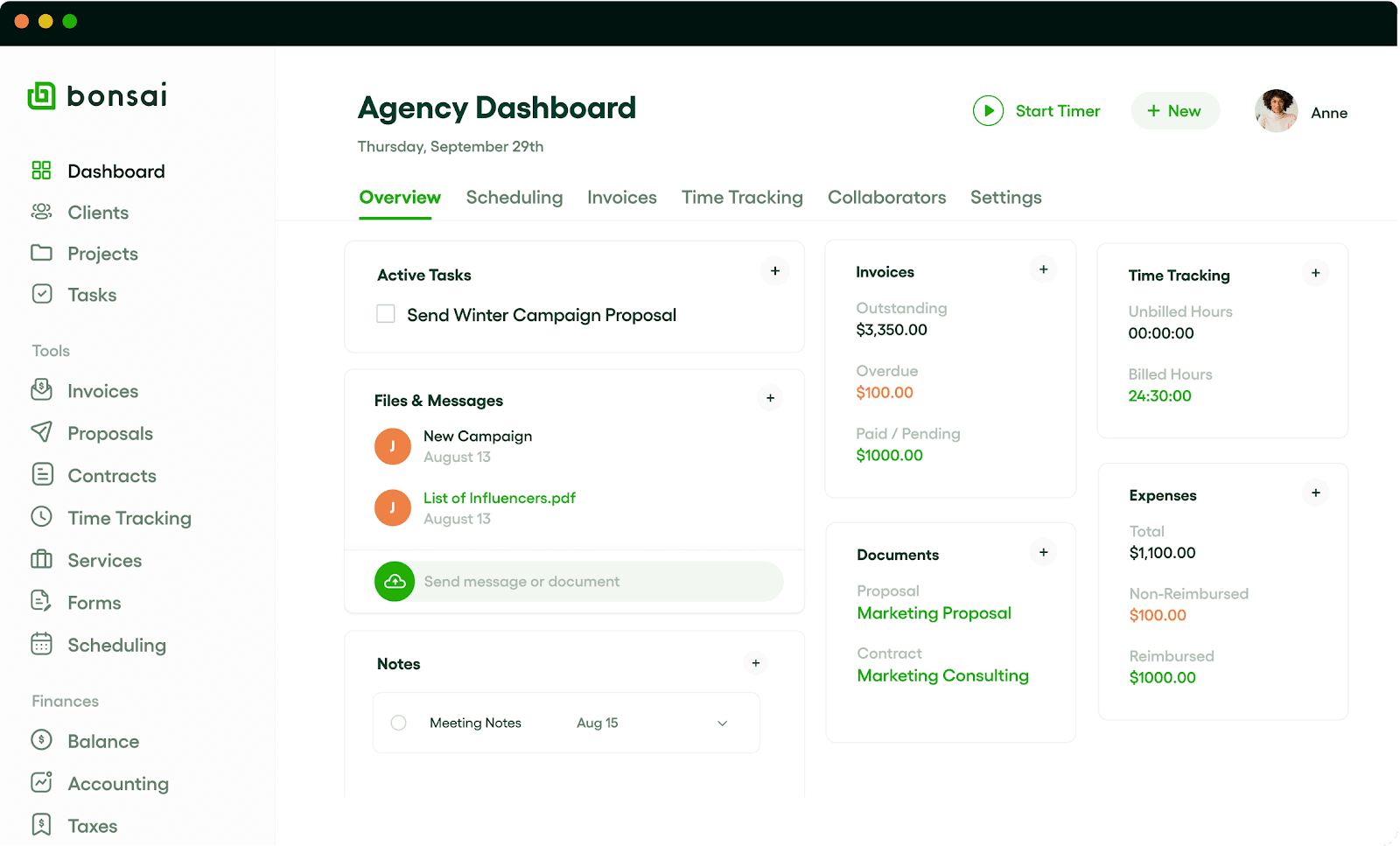
An all-in-one platform is the best solution for many organizations, including startups and small businesses. These comprehensive platforms cover most of the organization’s needs, making them more convenient, cost-effective, and scalable. With an all-in-one solution, your organization can have a more general outlook rather than limit itself to a specific area.
In business, comprehensive tools like Bonsai are life-savers for companies from various fields, including marketing.
As for the marketing world, the most popular all-in-one platforms include HubSpot, Buffer, and ActiveCampaign.
Use a combination of tools
Some companies, mainly large organizations and enterprises, might prefer to invest in several specialized tools for business and marketing purposes. For instance, they might get separate tools for client management and billing in the business department. For their marketing, they might opt to use specialized tools for:
- Email marketing
- Content management
- Testing
But why?
Using a combination of specialized tools allows these organizations to tailor various solutions to their specific needs. After all, a standalone tool can go into much more detail within its domain than an all-in-one option ever could.
Here are the most popular dedicated marketing automation platforms for agencies:
- MailChimp: email marketing
- Encharge: marketing automation
- Instapage: post-click landing pages
- Adobe Express (formerly ContentCal): content creation
Key tasks agencies can automate
Lead capture and qualification
Agencies can automate lead capture by using tools like HubSpot or ActiveCampaign to collect visitor information through forms and landing pages. These platforms automatically store leads in a CRM, eliminating manual data entry and reducing errors. Automation can also qualify leads by scoring them based on engagement, such as website visits or email opens, helping agencies prioritize high-potential prospects.
For example, an agency might set up a chatbot on their website using Drift or ManyChat to engage visitors instantly, answer common questions, and gather contact details. This real-time interaction increases lead capture efficiency and improves the user experience. By automating lead qualification, agencies save time and focus sales efforts on leads most likely to convert.
To implement this, start by integrating your website forms with a CRM and setting lead scoring rules based on your ideal customer profile. Regularly review and adjust criteria to ensure automation targets the right prospects. This approach streamlines the sales funnel and boosts conversion rates effectively.
Client onboarding and communication
Automating client onboarding reduces repetitive tasks and speeds up the process. Agencies can use platforms like HelloBonsai or Dubsado to send welcome emails, contracts, and questionnaires automatically once a client signs up. These tools also schedule follow-ups and reminders, ensuring no step is missed during onboarding.
For instance, an agency might automate sending a personalized welcome packet with project timelines and FAQs right after contract approval. This keeps clients informed and engaged without requiring manual outreach. Automation also helps maintain consistent communication through scheduled check-ins or progress updates using email sequences or SMS alerts.
To get started, map out your onboarding workflow and identify repetitive touchpoints. Then, set up automated triggers and templates in your chosen platform. This not only improves client experience but also frees up your team to focus on delivering quality work.
Social media management and scheduling
Agencies can automate social media posting and monitoring using tools like Buffer, Hootsuite, or Later. These platforms allow scheduling posts across multiple channels weeks in advance, ensuring consistent content delivery without daily manual effort. Automation also tracks engagement metrics, helping agencies adjust strategies based on real-time data.
For example, an agency managing multiple client accounts can batch-create content and schedule it for optimal times using these tools. They can also set up alerts for brand mentions or comments, enabling timely responses without constant manual monitoring. This improves efficiency and maintains active social profiles for clients.
To implement, create a content calendar and use scheduling tools to automate posting. Combine this with social listening features to stay responsive. This approach saves time and enhances client satisfaction by keeping their social presence vibrant and engaging.
Client reporting and analytics
Automating client reporting saves agencies hours of manual data compilation each month. Platforms like Google Data Studio, AgencyAnalytics, or SEMrush enable agencies to pull data from multiple marketing channels into customizable dashboards. These reports update automatically and can be scheduled to send to clients regularly.
For example, an agency can create a dashboard showing SEO rankings, PPC performance, and social media engagement for each client. Automated reports provide clear insights without the need for manual spreadsheets, improving transparency and client trust. Agencies can also set alerts for significant changes, enabling proactive strategy adjustments.
Start by identifying key performance indicators for each client and connecting relevant data sources to your reporting tool. Automate report delivery on a weekly or monthly basis to keep clients informed effortlessly. This practice enhances professionalism and frees up time for strategic work.
How to implement marketing automation in agencies
With the basics out of the way, it’s time to choose the specific marketing automation platform for your agency. Once you do, you’ll learn how to best integrate it with your existing tools and systems.
Choose the right marketing automation platform
With many marketing automation platforms on the market, choosing one for your agency can be a daunting task. Consider these factors to make the process easier.
- Budget. Unfortunately, your budget often dictates your options, so let’s start there. Choose a platform that offers the best value for money, reviewing its number of users, clients, and features.
- Features. Even tools marketed as “all-in-one” don’t actually contain all the marketing automation tools you might need. So, before committing to a purchase, list your needs and cross-reference them with various platforms’ offerings. The one with the most matches wins!
- Scalability. The goal of every business owner is to grow their business. So, choose a platform that can grow with you. This growth is best accomplished through various plug-ins and add-ons, so prioritize a marketing automation platform with a robust ecosystem.
- Ease of use. The whole point of a marketing automation tool is to make your life (and job) easier. So, any platform with a complex user interface and a steep learning curve should automatically be off the table.
With these factors in mind, let’s see how some of the most popular marketing automation platforms compare.

Integrate with existing tools and systems
Your chosen marketing automation tool shouldn’t exist in a vacuum. Integrating it with your existing tools and systems is the best way to maximize its effectiveness (while minimizing your effort).
For instance, you can integrate Bonsai with Zapier, allowing you to connect with content automation platforms like:

This is excellent news for business owners, as CRM integration is arguably the most crucial aspect of introducing a new tool into your business suite.
Besides CRM, make sure the marketing automation software can integrate with your existing social media management, analytics, and reporting tools. Choose the marketing automation platform well, and you’ll be able to eliminate some of the existing tools.
Frequently asked questions about marketing automation for agencies
How can marketing automation improve agency client management?
Marketing automation improves agency client management by streamlining repetitive tasks such as:
- Email campaigns
- Lead nurturing
- Reporting
This allows agencies to focus more on strategy and personalized client interactions. Using tools like HubSpot or ActiveCampaign, agencies can set up automated workflows that send targeted emails based on client behavior, reducing manual follow-ups.
Automation helps agencies track client engagement in real time, enabling quicker responses to leads and better campaign adjustments. Agencies that implement automation report up to 30% faster lead conversion times, according to recent 2024 industry data. This efficiency enhances client satisfaction and retention.
To get started, agencies should map out their most time-consuming client management tasks and identify which can be automated using platforms like Mailchimp or Zoho CRM. This targeted approach ensures a smoother transition and maximizes the benefits of automation.
What are the best marketing automation tools for agencies in 2024?
The best marketing automation tools for agencies in 2024 combine ease of use, scalability, and integration capabilities. HubSpot remains a top choice because it offers a comprehensive CRM, email marketing, and analytics in one platform, ideal for agencies managing multiple clients. Another popular option is ActiveCampaign, known for its advanced automation workflows and affordable pricing.
For agencies focusing on social media, tools like Buffer and Hootsuite integrate automation features that schedule posts and analyze performance. Platforms like Zapier help agencies connect different apps to automate complex workflows without coding. Choosing the right tool depends on the agency's size, client needs, and budget.
Agencies should trial multiple platforms using free versions or demos to see which fits their workflow best. Prioritizing tools with strong customer support and regular updates will ensure long-term success with marketing automation.
How do agencies measure the ROI of marketing automation?
Agencies measure the ROI of marketing automation by tracking key performance indicators (KPIs) such as:
- Lead conversion rates
- Client acquisition costs
- Campaign engagement levels before and after automation implementation
Comparing these metrics directly helps quantify time saved and revenue growth attributable to automation.
If an agency reduces time spent on manual email follow-ups by 50%, it can calculate labor cost savings. Tools like Google Analytics and CRM dashboards provide data on increased website traffic and lead quality, which contribute to ROI calculations. Agencies often see ROI improvements of 20-40% within the first year of adopting automation.
To accurately measure ROI, agencies should set clear goals before launching automation and use consistent tracking methods. Regularly reviewing these metrics allows for ongoing optimization and justifies further investment in automation technologies.
What challenges do agencies face when implementing marketing automation?
One common challenge agencies face when implementing marketing automation is the initial learning curve. Staff may need time to become proficient with new tools like Marketo or Pardot. This can delay full adoption. Additionally, integrating automation platforms with existing systems can create technical hurdles. This is especially true if client data is siloed across multiple sources.
Another challenge is maintaining personalized communication while automating repetitive tasks. Over-automation can lead to generic messaging that disengages clients. Agencies must carefully balance automation with human touchpoints to retain authenticity. For example, setting triggers for personalized follow-ups based on client behavior can help maintain relevance.
To overcome these challenges, agencies should invest in training, start with small automation projects, and choose platforms known for ease of integration.
Regularly reviewing automation outcomes ensures that processes remain effective and aligned with client expectations.
Best practices for marketing automation for agencies
You’ve chosen the best marketing automation tool for your agency. Take it one step at a time. Introducing any new concept requires time, patience, and strategic planning. Marketing automation is no different.
Develop a marketing automation strategy
A marketing automation tool will rid you of any mundane and repetitive tasks, streamlining virtually every marketing-related procedure in the process. However, you’ll first need a comprehensive strategy to guide this powerful tool.
Setting Clear Goals and Objectives
Before implementing any strategy, you need to define how that strategy aligns with your overall business goals. So, Step 1 in developing a marketing automation strategy is to outline your goals.
Your goal can be to build a robust omnichannel presence, streamline social media management, or personalize your website experience. Setting clear goals and objectives will help you do two things:
- Provide a clear direction for your marketing efforts
- Establish measurable benchmarks to gauge your strategy’s success
Understanding the Customer Journey
To determine which parts of your marketing funnel need optimization (and automation) the most, you must understand the customer journey. Once you do this, you can use email, social media, and landing page automation to create a fully automated marketing funnel.
For instance, let’s say you’re a photographer who wants to promote an online photography course. You can use your automation tool to schedule social media posts (and ads) promoting a free photography webinar first.
However, those who sign up for the webinar should automatically receive emails about your (paid) course. Set your auto-responder to send emails over 10 days, and you significantly increase your chances for conversion.
Content Planning and Personalization
When it comes to content marketing, quality always trumps quantity. Sure, scheduling lots of “filler” posts or writing short emails throughout the month might give you an impression of consistency. However, you won’t truly engage your audience without valuable and meaningful content.
So, before getting to the automation part, carefully plan out your posts, personalizing them to your target audience. Create dynamic and engaging content, and any automated marketing communications follow-up will be a raging success.
Measure and analyze performance

Marketing and analytics tools must work as a single unit. Otherwise, how will you know whether your marketing automation strategy has been successful? Use analytics to gather data, measure performance, and analyze it, and you’ll always know what works and what doesn’t. That’s not to mention that over 50% of companies extensively using marketing analytics tools end up with higher profits.
Fortunately, the best marketing automation tools have built-in analytics capabilities, allowing you to launch campaigns and measure their effectiveness in a unified platform. But first, you must learn how to measure and analyze performance correctly.
Step 1 – Set Key Performance Indicators (KPIs)
To analyze the results of your marketing strategy, you must first define your success metrics. Enter Key Performance Indicators (KPIs). Set concrete KPIs before your campaign starts, and you’ll know what specific benchmarks to track throughout your campaign.
Here are some of the most popular KPIs in the marketing world:
- Sales revenue
- Cost of customer acquisition
- Customer lifetime value
- Marketing return on investment (ROI)
- Lead conversion rate
Regular Audits and Adjustments
When it comes to digital marketing, it’s important to remember one thing – your job is never done. So, even after launching a campaign, you should regularly audit your analytics and make the necessary adjustments to ensure ongoing success. In other words – always listen to the data!
Leveraging Analytics for Continuous Improvement
Chances are not all your marketing strategies will be successful. And that’s perfectly fine. The important thing is to learn from your failures and use the data gathered through analytics to improve your future projects.
Challenges and solutions in marketing automation for agencies
As beneficial as marketing automation for agencies is, it doesn’t come without challenges. Keep reading to learn what those challenges are and how to overcome them.
Common challenges faced by agencies in marketing automation
Data Quality and Management
With large-scale automation, challenges in data quality and management are common. Inaccurate or incomplete data can significantly hinder the automation process, ultimately impacting the effectiveness of your campaigns. As for data management, tools that don’t integrate data into a central repository can cause data silos, leading to inefficiencies and inconsistencies.
Balancing Automation and Personalization
The more marketing processes get automated, the more challenging it gets to maintain a personalized touch. If you “over-automate” your processes, your audience will likely catch on, and you risk losing the potential connection with leads.
Keeping Up With Evolving Technology
The marketing world never sleeps. The same goes for the tech field. Combine these two, and you get a challenging landscape that demands constant adaptation. Throw new budgetary demands and additional skills into the mix, and it becomes obvious how this challenge can impact every facet of an agency’s marketing efforts.
How to overcome marketing automation challenges
Implementing Effective Data Management Practices
Agencies struggling with data management should pair their automation tools with data integration tools or a customer data platform like Bonsai. This pairing will allow the marketing team to consolidate data from various sources, guaranteeing a 360-degree view of the customer journey.
As for the data quality, it’s all about verification. Implement data checks from the entry point to ensure accuracy throughout the system.
Fostering Creativity in Automated Campaigns
Just because your marketing campaigns are automated doesn’t mean they must also be repetitive, predictable, and devoid of creativity. As long as you approach every campaign from a fresh, new angle, your customers will never get the feeling they’re talking to or shopping from a machine.
Continuous Learning and Adaptation

There’s no use getting frustrated over the constant changes in the marketing and technology worlds. Instead, mimic their behavior. Keep up with the industry trends, invest in your (and your employee’s) education, and only work with scalable tools. The result? Whatever happens, you’ll be able to adapt.
Future trends in marketing automation for agencies
Marketing automation is an ever-expanding field. Let’s explore what the future holds for this exciting tool and how to prepare for what’s coming.
Explore emerging technologies and their impact on marketing automation
Discover the technologies that will help shape the marketing automation field in the (near) future.
Artificial Intelligence and Machine Learning
As of 2024, 61.4% of marketers have used artificial intelligence (AI) in their marketing activities. Given how quickly AI exploded in popularity, it’s easy to conclude that this percentage will only keep growing.
But how does AI help marketing automation? Reducing data-processing time and delivering more meaningful (and actionable) insights are just the tip of the iceberg. AI will undoubtedly revolutionize every aspect of marketing automation in the future, from enhanced personalization to dynamic content generation.
Predictive Analytics
Predictive analytics is another significant trend shaping the future of marketing automation for agencies. Coincidentally, it’s also another trend influenced by AI.
By using advanced AI algorithms, marketers will be able to anticipate customer behaviors and market trends. Armed with this knowledge, they can proactively tailor marketing strategies to make them successful beyond compare.
Personalization at Scale
As mentioned, there’s a looming fear that too much automation will lead to a complete loss of personalization. However, advanced AI algorithms will ensure this doesn’t happen (again!). These algorithms can analyze vast amounts of data to understand individual preferences, behaviors, and engagement patterns. The result? The perfect blend of efficiency and personalization.
Prepare for the future of marketing automation
One thing’s evident by now – there’s no stopping marketing automation. Many experts believe we’ve only scratched the surface of what this transformative tool can achieve. Here’s how to be ready for whatever the future holds:
- Stay informed on industry changes. Join professional associations, attend relevant conferences, and keep up with the industry leaders, and you’ll always stay at the forefront of evolving trends.
- Invest in training and development. The more you (and your employees) get educated, the higher the chances of staying competitive.
- Build a culture of innovation. Up to 90% of executives list innovation as their top priority, and for a good reason. Only by building a culture of innovation within your agency can you adapt to whatever the exciting field of marketing automation comes up with next.
Automate success with marketing automation for agencies
Marketing automation is a powerful tool for agencies. Use it accurately, and your business will experience a range of benefits, including increased efficiency and revenue growth. The key is understanding the nuances of this tool. Use this guide to make marketing automation work effectively for your agency.


'%3e%3cg id='Final-Copy-2_2_' transform='translate(1275.000000, 200.000000)'%3e%3cpath class='st0' d='M7.4,12.8h6.8l3.1-11.6H7.4C4.2,1.2,1.6,3.8,1.6,7S4.2,12.8,7.4,12.8z'/%3e%3c/g%3e%3c/g%3e%3c/g%3e%3cg id='final---dec.11-2020'%3e%3cg id='_x30_208-our-toggle' transform='translate(-1275.000000, -200.000000)'%3e%3cg id='Final-Copy-2' transform='translate(1275.000000, 200.000000)'%3e%3cpath class='st1' d='M22.6,0H7.4c-3.9,0-7,3.1-7,7s3.1,7,7,7h15.2c3.9,0,7-3.1,7-7S26.4,0,22.6,0z M1.6,7c0-3.2,2.6-5.8,5.8-5.8 h9.9l-3.1,11.6H7.4C4.2,12.8,1.6,10.2,1.6,7z'/%3e%3cpath id='x' class='st2' d='M24.6,4c0.2,0.2,0.2,0.6,0,0.8l0,0L22.5,7l2.2,2.2c0.2,0.2,0.2,0.6,0,0.8c-0.2,0.2-0.6,0.2-0.8,0 l0,0l-2.2-2.2L19.5,10c-0.2,0.2-0.6,0.2-0.8,0c-0.2-0.2-0.2-0.6,0-0.8l0,0L20.8,7l-2.2-2.2c-0.2-0.2-0.2-0.6,0-0.8 c0.2-0.2,0.6-0.2,0.8,0l0,0l2.2,2.2L23.8,4C24,3.8,24.4,3.8,24.6,4z'/%3e%3cpath id='y' class='st3' d='M12.7,4.1c0.2,0.2,0.3,0.6,0.1,0.8l0,0L8.6,9.8C8.5,9.9,8.4,10,8.3,10c-0.2,0.1-0.5,0.1-0.7-0.1l0,0 L5.4,7.7c-0.2-0.2-0.2-0.6,0-0.8c0.2-0.2,0.6-0.2,0.8,0l0,0L8,8.6l3.8-4.5C12,3.9,12.4,3.9,12.7,4.1z'/%3e%3c/g%3e%3c/g%3e%3c/g%3e%3c/g%3e%3c/svg%3e)