





You’re an expert who can provide a specific service.
Perhaps you’re a marketing guru who specializes in getting a company’s websites to the top of Google. Alternatively, you know your way around a real estate deal and can help people buy or sell houses. Whatever the case may be, you sell a service, rather than a product.
And that means the agency model is right for you.
Now, the question is obvious:
What type of agency should you set up?
That’s the question this article answers as it explores the various types of agency and what each type does.

What is a type of agency in business terms?
There are two ways to look at the term “agency” in the business world:
- The legal definition of agency as it relates to a business.
- The agency business model.
They’re easy to conflate, though they mean very different things.
On the legal definition side, you have the concept of “agency theory.” This is a principle that explains a representative relationship in business. One party – the agent – represents the other, often called the principal, in day-to-day transactions. In most cases, the principal delegates decision-making responsibilities to their agent to act on their behalf.
For instance, an employee is an agent of an employer.
The employee has been appointed to a specific position, assuming responsibilities in the process. As a result, the employee has “agency,” at least within the scope of their employment. For instance, a project manager may have the agency to organize a project without direct input from their employer. However, that project manager is still acting as a representative of the employer. The work they produce is ultimately owned by somebody else.
Agency theory often applies in an agency business model in this respect.
But they’re not the same thing.
The agency business model is one in which you create a team of experts to solve an issue for a client. There are two keys here. First, the agency sells a service, rather than a physical product. In digital marketing, this service might be:
- SEO
- Online advertising campaigns
- Social media management
For the travel industry, an agency essentially sells the convenience of booking a holiday on your behalf. The actual products involved in that service – such as hotels – are provided by somebody else.
The second key is that an agency isn’t legally bound to act on behalf of its client.
In other words, it doesn’t represent the client. Rather, it receives requests or orders from that client, which it then fulfills. Sticking with the digital marketing example, imagine that you create a piece of content for a client’s website. That content is written from the client’s perspective and goes directly to the client.
It needs approval before it can be placed on a website.
As such, an agency isn’t a direct representative of a client in the way that an agent might be. It’s a tricky separation of concepts to wrap your head around. But in terms of the type of agency you create, you’re going to be focused on the business model rather than the legal definition.
How to use software to streamline your agency
No matter the type of your agency, Bonsai is the perfect tool to help your team run smoothly. You won’t need many tools because it has all the features every agency owner requires. Here are some ways Bonsai can help:
Manage your clients effectively
With Bonsai, you can easily keep track of your clients and manage your relationship with them. It has an integrated CRM that allows you to build your client list and keep their information in one place.

Learn more about Bonsai's CRM tool
Enable your client portal so they can access the projects, documents, and links you’ve shared. Your clients can also view their invoices there. You can add automations to streamline your workflows. For example, you can set a trigger so that when a client signs a contract, Bonsai automatically redirects them to the onboarding page.
To help you stay organized, add tags to your client list. This makes it easy to identify which products clients are interested in or what sales stage they are in.
Stay on top of your projects
Agencies often work with multiple clients. Staying methodical is crucial. Bonsai’s project management feature supports your team’s collaboration. You can easily invite team members to work on projects together.
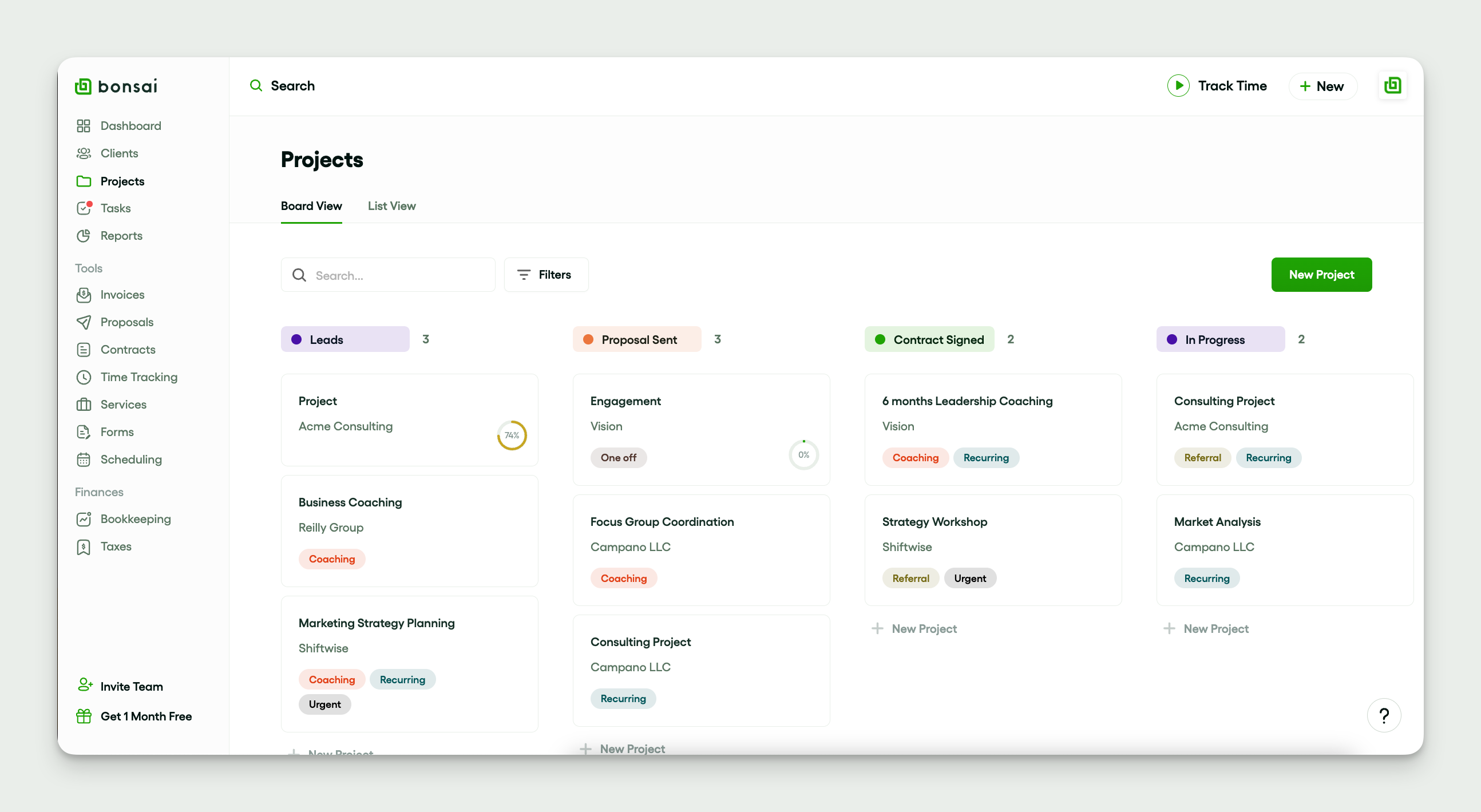
On the Projects tab, you get an overview of tasks, shared files, and billing details for specific projects. This helps managers organize and plan project delivery efficiently. Track time spent on projects and manage tasks using Bonsai to ensure smooth internal processes.
Keep your projects under budget
Bonsai also helps you manage your agency’s finances without switching to other financial software. Setting project budgets is easy and helps you stay financially on track without surprises. You can set budgets based on fees or time. For example, with a recurring contract, you can set a monthly fee. Adding an end date is optional for convenience.
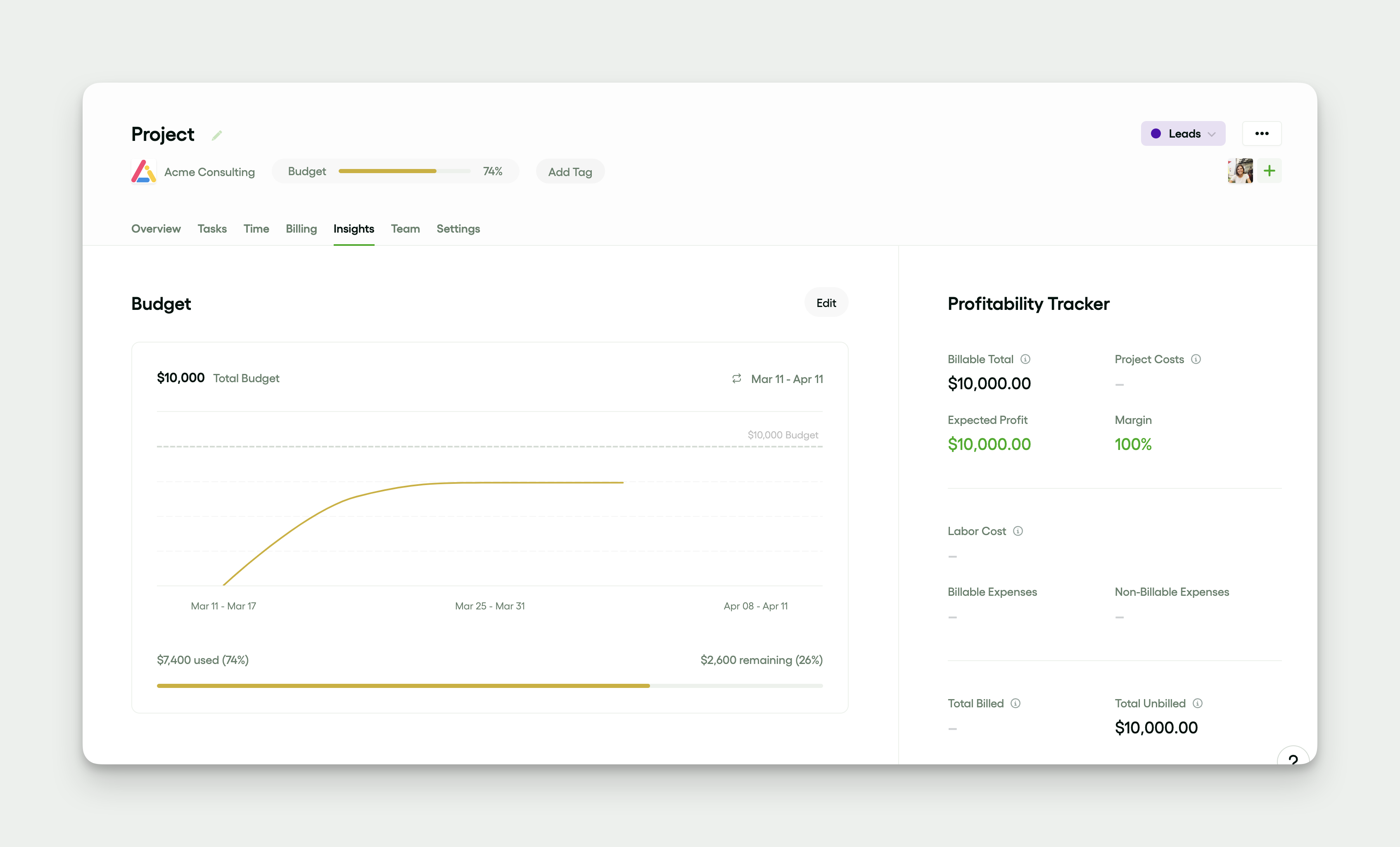
Once set, monitor your budget in real time on the project overview. As you track hours and add them to your project, you see live progress of your budget pacing. This feature is especially useful when managing multiple projects, with visual elements in board and list views displaying your budget status.
Updating your budget mid-project is simple. Navigate to project settings and make the necessary adjustments. For projects without budgets enabled, just enable the feature in settings, input your budget amount, and start your tracking. Bonsai simplifies budget management, helping you stay within budget and avoid unnecessary overtime.

Best project management software for all types of agencies
What are the types of agency to start?
The real answer to this question is simple:
Almost any service you can think of can have the agency business model built around it. If it’s a service that experiences demand, there’s a type of agency you can create.
With that in mind, don’t think of this list as a collection of the only agency types available. They’re simply the most common – with each offering specific types of agency services.

Digital marketing agency type
When most think of the agency business model, it’s this type of agency that comes to mind. Digital marketing agencies are responsible for enhancing their clients’ online presence. The concept is simple – the agency uses a host of techniques to drive traffic to websites and social media pages. Those techniques have the goal of driving conversions for the client.
A conversion could be a sale.
It could also be something like a sign-up to an email campaign, which the digital agency also oversees.
The key is that the agency gets more people talking to – and buying from – their clients.
If you’re considering forming this type of agency, you’re not alone. The digital marketing industry is growing rapidly and will be worth $965.6 billion by 2028. That growth represents a lot of opportunity for the prospective agency owner, though it also means tons of competition.
Types of agency services
A ton of services fall under the digital marketing agency umbrella, including:
- Search Engine Optimization (SEO)
- Pay-Per-Click Advertising (PPC)
- Social Media Management
- Content Marketing
- Email Marketing
- Affiliate Marketing
- Web Analytics
- Search engine optimization (SEO)
- Pay-per-click advertising campaign creation and management
- Social media marketing
- Email marketing
- Website design and development
- Online reputation management
- Content creation
However, not all digital marketing agencies offer every possible service. For every full-service agency, there are several focused on a specific niche. For instance, a content marketing agency is a digital marketing agency. But it’s not the agency to use if you need a PPC campaign created. Rather, it could create copy for that campaign without managing it. In some cases, a digital marketing agency can even provide clients with software to help with marketing campaigns.
Travel agency type
Travel agencies help individuals – or even entire groups – to plan, book, and execute vacations to various destinations. Think of them as service providers serving as intermediaries between a client and the various products or services they need for a vacation. For instance, travel agencies often book flights, hotels, and even car hire on behalf of their clients.
However, they don’t offer those services themselves.
They’re simply the grease on the cogs of vacation planning that ensure the whole trip comes together without a hitch.
Type of agency services
A travel agency’s services are divided into two categories:
- Consultation
- Making Bookings and Reservations
The consultation side is all about figuring out what the client wants from their vacation. Where do they want to go? What do they want to do at their destination? Where will they stay and are there any visa issues the client needs to handle? In short, the travel agency works with the client to determine what their vacation will look like.
That consultation feeds into the bookings and reservations aspect of the service.
Once the client has decided on what they want, the agency makes the appropriate reservations on their behalf. Flights, hotel rooms, cars, and activities are all pre-booked for the client. So, all the client has to do is pay their money and receive their tickets.
Real estate agency type
A staggering 4.8 million people bought homes in the United States in 2023. Of those homebuyers, 86% used a real estate agent to help them with their purchase. That amounts to 4.128 million people using this type of agency to help get them into a home.
So, what does a real estate agency do?
Like travel agents, real estate agents serve as intermediaries. When somebody wants to sell a property, they list it with a real estate agent who then advertises that property for them. That property attracts potential buyers. And when a buyer makes an offer, the agent delivers that offer to the seller, along with advice based on their market expertise.
Ultimately, these agents make it easier for people to buy and sell properties.
Type of agency services
Real estate agents offer several services as part of their function as property intermediaries, typically in service of a seller.
For instance, they’ll handle the marketing of a property by listing it for sale on their website along with property aggregators. They’ll also conduct viewings, allowing potential buyers to see the property, and carry out negotiations for their client. However, these negotiations ultimately go through the client. The real estate agency doesn’t act as a business agency.
Some real estate agents also work as property managers.
In this role, they’ll oversee rental properties on behalf of their clients. Marketing and finding tenants is a part of that service, as is ensuring rents are paid on time. As they offer a more advanced service than simple selling, property managers will usually need a good agency CRM in place.
By the way, there are also real estate agents who act on behalf of buyers – they’re called buyer’s agents. Their primary functions are to find properties that match a client’s requirements and then negotiate a price with the seller.
Branding agency type
Hold on a second.
The article has already covered digital marketing agencies. How are branding agencies any different?
It all lies in the focus area. While both digital marketing and branding fall under the general “marketing umbrella,” they’re two different things. A digital marketer focuses on getting more eyes on a company. Branding specialists ensure that the message being delivered to those people remains consistent and aligned with their client’s values.

A branding agency’s service is mostly about distinguishing a client’s company from its competitors. What makes the client special? What is their unique selling point (USP)? What is the company’s target audience and what message does that audience need to hear from the client?
These are the questions a branding agency answers. And while there’s a crossover with digital marketing – branding companies may create content guidelines that copywriters follow, for instance – they’re distinct specializations.
Types of agency services
Branding agencies focus mostly on strategy.
They help clients understand the concept of a “brand,” which is essentially a product or service that’s distinguishable enough to be considered unique. With that concept in place, the agency works with its clients to create that brand. This may involve starting from the ground up – developing mission and vision statements. But it’ll more typically involve ensuring the client’s messaging on every platform aligns, both with itself and with the target audience’s needs.
A branding agency may also be responsible for logo design and other graphic representations of a company. Plus, it’ll typically solidify the company’s branding in guidelines that may be used by other agencies.
Artificial intelligence (AI) agency type
Though the concept of AI services had existed long before, ChatGPT ushered in explosive growth for the AI sector. It’s projected to become massive in the coming years. Statista says that AI will enjoy a compound annual growth rate (CAGR) of 15.83% between 2024 and 2030.
The result?
A market volume of $738.8 billion.
So, where does an AI agency fit into all of this?
Rather than creating AI solutions, AI agencies help businesses maximize this emerging technology. This could be as simple as introducing clients to project management software with AI-powered workflow automations. It could also involve developing a full AI strategy designed to cut costs and boost revenue.
Type of agency services
It’s difficult to define specific AI agency services.
The technology is new, and the services around it are nebulous, so AI agencies branch out in multiple directions. Many focus on marketing. For example, an agency may include “prompt experts” who ensure software like ChatGPT outputs publishable marketing content. Others focus on data analysis, especially for larger companies. The volume of data large companies generate is massive. AI agencies help develop solutions to sift through data and find real insights, which can be a massive boon.
Ultimately, AI agencies use artificial intelligence to achieve at least one of three goals for their clients:
- Improve operational efficiency
- Enhance decision-making capabilities
- Save money by cutting down on manual work
Recruiting agency type
Employment agencies, also known as recruitment agencies, help businesses find suitable candidates for vacant roles. Similar to real estate and travel agencies, recruitment agencies act as intermediaries:
The hiring company tells the recruiting agency what they want and the agency goes out to find it.
So, the agency’s role is twofold. It’ll work with its clients to determine what an “ideal candidate” looks like for a role. Once it knows that – and what the role entails – it’ll advertise to jobseekers. Often, recruiting agencies will keep some of the best roles their clients offer in-house to encourage job seekers to sign up.
The question is why would an employer use a recruiting agency?
Services like Indeed and Monster have made advertising roles easier. However, recruiting agencies still offer value beyond job board listings.
That’s not the case for a simple reason – many business leaders find it hard to fill positions with skilled people. Specifically, nearly three-quarters (70%) say it’s hard to find talent to get rid of the skill gaps in their companies. So, recruiting agencies serve the purpose of finding that talent on the recruiting company’s behalf.
Type of agency services
The main service a recruitment agency offers are covered above. They find potential candidates for their clients.
However, the service extends beyond that simple requirement in many cases.
For instance, the agency may essentially act as a candidate repository for its client. It gathers candidates and stores their details in a database – typically using CRM software – for the client to peruse as needed.
Recruitment agencies also have a marketing component.
On the obvious level, they “sell” candidates on the role a candidate wants to fill. This marketing may include helping the client create attractive job postings and ensuring those posts are placed on relevant websites. Some recruitment agencies even have a branding component – they ensure job posts align with the client’s messaging.

Type of agency niches that are less ordinary
The six agency types discussed above are either the most common or agency types that are becoming more popular thanks to new technology. But remember the statement made at the beginning of the article:
Almost any service you can think of can have the agency business model built around it.
To demonstrate that, the following is a quick list of niche agencies that are a little outside of the norm.
Remote work optimization agency
With 32.6 million Americans anticipated to be working remotely by 2026, businesses must adapt. The old office setup won’t work for many anymore. They need to introduce remote or hybrid work models.
That’s where this kind of agency comes in.
Remote work optimization agencies typically serve as consultants and change management experts. They help clients – usually businesses – to adapt to the work-from-home concept. They may even help with policy drafting and technology recommendations.
Podcasting agency
People love podcasts.
Statista says that 79% of American adults were aware of podcasting in 2023. The previous year, an enormous 81 million had listened to at least one podcast.
Podcasting agencies help people with podcasts reach the people who listen to podcasts. They’re one part marketing agency – helping listeners to discover the podcast – and one part representative. For instance, a podcaster may use an agency to help them get on popular platforms like Spotify and Apple Music.
Sustainability consulting agency
Consumers and businesses care more about sustainability than ever before. On the consumer side, 78% of Americans say living a sustainable lifestyle is important to them. That puts the onus on companies to provide sustainable products to serve that need.
But it’s not just about products.
Companies also need to adopt sustainable practices as part of their branding if they’re to appeal to more environmentally aware clients.
Enter the sustainability consulting agency.
These types of agencies work with businesses to help them become more sustainable. They may include conducting audits – of the company’s products and practices – to determine where wastage occurs. The agency might also make recommendations or formulate strategies to boost a client’s sustainability credentials.

Type of agency choices limited only by your imagination
You’ll see this is far from an exhaustive list of agencies. However, there’s a common thread running through each type of agency covered:
All provide a service or services that is in demand via a business model that makes it easy for clients to work with them. The secret to agency success lies here: as long as an agency owner streamlines their service to make it as easy to use as possible, they’ll always have clients.
Of course, backing up the promises the agency makes is crucial.
Service delivery ultimately determines how many clients an agency attracts or loses. Add to that the use of appropriate software for agency management, and the only limit is your imagination.
If it’s a service that people (or businesses) want, it’s a service around which you can build an agency.
Public relations (PR) agency
What a public relations agency does
A public relations (PR) agency manages the communication between a business and its audience to build a positive reputation. These agencies craft press releases, organize media events, and handle crisis communication to ensure the company’s message is clear and favorable. For example, a PR agency might help a startup announce a new product launch by securing media coverage in industry publications.
PR agencies monitor public opinion and media trends to adjust strategies quickly. They use tools like Cision or Meltwater to track mentions and analyze brand perception online and offline. This ongoing monitoring helps businesses respond to negative press or capitalize on positive buzz effectively.
For freelancers and small business owners, partnering with a PR agency can increase brand visibility without the need for a large marketing budget. Knowing what a PR agency does helps you decide if outsourcing your communication efforts will improve your business growth.
How to choose the right PR agency
Choosing the right PR agency starts with identifying your business goals. If you want to increase media coverage, look for agencies with strong media connections in your industry. For example, a tech startup should seek a PR agency experienced with technology reporters and outlets like TechCrunch or Wired.
Evaluate agencies based on past results and client testimonials. Request case studies that show measurable outcomes, such as increased press mentions or event attendance. Also, consider the agency’s size and service scope. Smaller agencies might offer more personalized service, while larger ones provide broader reach.
Finally, discuss your budget upfront. PR agencies often offer retainer packages starting around $3,000 per month in 2024, but some freelancers or small businesses may find success with project-based pricing. Clear communication about expectations and costs ensures a productive partnership.
How to work effectively with a PR agency
Establish clear communication channels from the start to get the most from a PR agency. Schedule regular check-ins, such as biweekly calls, to review progress and adjust strategies. Use collaboration tools like Slack or Trello to streamline updates and feedback.
Provide the agency with detailed information about your products, target audience, and company values. This helps them craft authentic messages that resonate with your customers. For example, sharing customer testimonials or product demos can enhance media pitches and story angles.
Set measurable goals together, such as securing five media mentions in three months or increasing social media engagement by 20%. Tracking these metrics with tools like Google Analytics or social listening platforms helps you evaluate the agency’s impact and make informed decisions.
Social media agency
What a social media agency does
A social media agency specializes in managing and growing a brand's presence across platforms like Facebook, Instagram, TikTok, and LinkedIn. Their main goal is to create content, engage audiences, and run paid advertising campaigns that drive traffic and sales. This type of agency focuses on building relationships between businesses and their customers through consistent, targeted social media efforts.
For example, a social media agency might develop a content calendar tailored to a small business’s target audience, schedule posts using tools like Hootsuite or Buffer, and monitor engagement metrics weekly. They also handle community management by responding to comments and messages promptly to boost customer loyalty.
Understanding these core tasks helps freelancers and small business owners decide if hiring a social media agency fits their marketing needs. If your goal is to increase brand awareness and sales via social platforms without managing daily posts yourself, this agency type offers a practical solution.
How to choose the right social media agency
Choose the right social media agency by identifying your business goals and budget. Agencies vary widely in specialization. Some focus on paid ads, while others excel in organic content creation or influencer partnerships. Clarify whether you want to boost follower count, improve engagement rates, or drive website conversions.
Next, review case studies and client testimonials to assess an agency’s track record. For instance, a local boutique might look for an agency experienced in lifestyle brands with proven success increasing Instagram sales by 20% or more within three months. Tools like Clutch.co and Agency Spotter provide verified reviews to help with this research.
Finally, ask about reporting and communication frequency. Transparent agencies provide monthly performance reports using platforms like Google Analytics and Facebook Insights, enabling you to track ROI clearly. This ensures you stay informed and can adjust strategies as needed.
Benefits of working with a social media agency
Hiring a social media agency saves time and leverages expert knowledge to create more effective campaigns. Agencies stay updated on platform algorithm changes and trends, which is crucial in 2024 as platforms like TikTok continue evolving rapidly. This expertise helps your brand stay relevant and competitive.
Additionally, agencies often have access to advanced tools like Sprout Social or SEMrush that provide deeper insights into audience behavior and competitor strategies. Small businesses without these resources can gain a significant advantage by outsourcing social media management.
Ultimately, working with a social media agency allows you to focus on core business activities while professionals handle marketing execution. To maximize benefits, set clear goals upfront and maintain regular communication to ensure the agency’s efforts align with your vision.
Advertising agency
What is an advertising agency?
An advertising agency is a company that creates, plans, and manages advertising campaigns for businesses. It helps brands reach their target audience through various media channels like TV, social media, print, and digital ads. These agencies focus on promoting products or services to increase sales and brand awareness.
For example, a small business owner launching a new product might hire an advertising agency to design a social media campaign that drives traffic and sales. Agencies often use tools like Google Ads and Facebook Ads Manager to target specific demographics, ensuring ads reach the right customers efficiently.
Understanding what an advertising agency does helps freelancers and small business owners decide when to outsource marketing efforts. If you lack time or expertise to run effective campaigns, partnering with an agency can save you resources and improve your reach.
How advertising agencies work with clients
Advertising agencies typically start by understanding your business goals and target market. They conduct research to identify the best channels and messaging that resonate with your audience. This initial step ensures campaigns are tailored to your specific needs.
Next, agencies develop creative concepts and media plans, often presenting multiple options for you to review. Once approved, they execute the campaign, monitor performance using analytics tools like Google Analytics or HubSpot, and adjust strategies based on real-time data. This ongoing optimization helps maximize your return on investment.
For freelancers and small business owners, it’s important to communicate clear objectives and budget limits upfront. Agencies can then recommend cost-effective solutions, such as targeted Facebook ads costing as little as $5 per day, which can deliver measurable results without overspending.
Choosing the right advertising agency for your business
Selecting the right advertising agency depends on your industry, budget, and marketing goals. Look for agencies with experience in your niche or with similar business sizes. For example, a local restaurant may benefit more from an agency specializing in food and beverage marketing than a generalist firm.
Check for transparent pricing models and clear deliverables. Some agencies charge a flat monthly fee, while others work on project-based pricing or commission from ad spend. Understanding these details helps avoid surprises and ensures your investment aligns with expected outcomes.
Finally, review case studies and client testimonials to gauge an agency’s effectiveness. Many agencies showcase successful campaigns on their websites, which can provide insight into their creativity and results. Taking these steps will help you find a partner that drives growth and fits your business needs.
growth marketing agency
what is a growth marketing agency?
A growth marketing agency focuses on driving scalable business growth through data-driven strategies and continuous experimentation. Unlike traditional marketing, which often emphasizes brand awareness or one-off campaigns, growth marketing targets measurable results like customer acquisition, retention, and revenue growth.
These agencies combine techniques such as A/B testing, conversion rate optimization, and multichannel marketing to identify the most effective tactics. For example, a growth marketing agency might run targeted Facebook ads while simultaneously optimizing a website’s landing page to increase sign-ups.
Understanding this difference helps freelancers and small business owners choose an agency that prioritizes ROI and sustainable growth over just visibility or impressions.
how growth marketing agencies drive results
Growth marketing agencies use a systematic approach to test and refine marketing tactics quickly. They start by analyzing customer data and setting clear goals, such as increasing monthly recurring revenue by 20% within six months. From there, they design experiments to validate assumptions and scale what works.
For instance, an agency might test different email subject lines using tools like Mailchimp or Klaviyo to improve open rates. They also leverage platforms like:
- Google Analytics
- Hotjar
to track user behavior and identify drop-off points in the sales funnel.
Small businesses can apply this mindset by regularly reviewing campaign data and making incremental changes rather than relying on a single marketing push. This iterative process is key to sustainable growth in 2024 and beyond.
when to hire a growth marketing agency
Hiring a growth marketing agency makes sense when your business has product-market fit but needs help scaling customer acquisition efficiently. If you’ve tried basic marketing tactics without clear ROI or want to expand into new channels like paid social or SEO, a growth agency can provide expertise and resources.
For example, a SaaS startup aiming to increase trial sign-ups by 30% in the next quarter could benefit from a growth agency’s ability to run multivariate tests and optimize the onboarding process. On the other hand, very early-stage businesses might focus first on product development before investing in growth marketing.
Before hiring, clarify your growth goals and budget. Many agencies offer flexible packages or project-based work, which is ideal for freelancers and small businesses looking to test growth marketing without long-term commitments.
Digital marketing agency
What a digital marketing agency does
A digital marketing agency specializes in promoting brands and products online using various internet-based channels. These agencies create strategies that include:
- Search engine optimization (SEO)
- Pay-per-click (PPC) advertising
- Social media marketing
- Email campaigns
- Content creation
Their goal is to increase a business’s online visibility and drive targeted traffic to websites or landing pages.
For example, a digital marketing agency might run Google Ads campaigns to generate leads for a local plumbing company or manage Instagram ads for an e-commerce store. They also track performance metrics using tools like Google Analytics and Facebook Ads Manager to optimize campaigns in real time. This data-driven approach helps ensure marketing budgets are spent efficiently.
Understanding what a digital marketing agency does helps freelancers and small business owners decide if outsourcing these services can boost their growth. If your business lacks in-house marketing expertise, partnering with an agency can save time and deliver measurable results.
How to choose the right digital marketing agency
Choosing the right digital marketing agency starts with defining your business goals. Are you looking to increase website traffic, generate leads, or build brand awareness? Knowing your objectives helps you find an agency with relevant experience. For example, some agencies specialize in B2B lead generation, while others focus on social media for consumer brands.
Next, review the agency’s portfolio and client testimonials to assess their track record. Tools like Clutch.co provide verified reviews and case studies. Also, check if the agency uses up-to-date platforms such as Google Ads, Meta Business Suite, and HubSpot for marketing automation. Transparency about pricing and deliverables is essential to avoid unexpected costs.
Finally, schedule a consultation to discuss your needs and evaluate communication style. An agency that understands your industry and communicates clearly will be a better partner. Taking these steps ensures you select a digital marketing agency that aligns with your budget and growth plans.
How freelancers can leverage digital marketing agencies
Freelancers can benefit from collaborating with digital marketing agencies by expanding their service offerings without needing to master every skill. For instance, a freelance graphic designer can partner with an agency to provide creative assets for campaigns, while the agency handles strategy and media buying. This creates new revenue streams and client opportunities.
To start, freelancers should identify agencies that complement their expertise and reach out with a clear proposal. Platforms like LinkedIn and Upwork can help find agencies open to collaboration. Establishing a referral or subcontracting agreement ensures both parties benefit financially and professionally.
By leveraging digital marketing agencies, freelancers can focus on their strengths while delivering comprehensive solutions to clients. This approach helps build a stronger portfolio and long-term client relationships in 2026 and beyond.


'%3e%3cg id='Final-Copy-2_2_' transform='translate(1275.000000, 200.000000)'%3e%3cpath class='st0' d='M7.4,12.8h6.8l3.1-11.6H7.4C4.2,1.2,1.6,3.8,1.6,7S4.2,12.8,7.4,12.8z'/%3e%3c/g%3e%3c/g%3e%3c/g%3e%3cg id='final---dec.11-2020'%3e%3cg id='_x30_208-our-toggle' transform='translate(-1275.000000, -200.000000)'%3e%3cg id='Final-Copy-2' transform='translate(1275.000000, 200.000000)'%3e%3cpath class='st1' d='M22.6,0H7.4c-3.9,0-7,3.1-7,7s3.1,7,7,7h15.2c3.9,0,7-3.1,7-7S26.4,0,22.6,0z M1.6,7c0-3.2,2.6-5.8,5.8-5.8 h9.9l-3.1,11.6H7.4C4.2,12.8,1.6,10.2,1.6,7z'/%3e%3cpath id='x' class='st2' d='M24.6,4c0.2,0.2,0.2,0.6,0,0.8l0,0L22.5,7l2.2,2.2c0.2,0.2,0.2,0.6,0,0.8c-0.2,0.2-0.6,0.2-0.8,0 l0,0l-2.2-2.2L19.5,10c-0.2,0.2-0.6,0.2-0.8,0c-0.2-0.2-0.2-0.6,0-0.8l0,0L20.8,7l-2.2-2.2c-0.2-0.2-0.2-0.6,0-0.8 c0.2-0.2,0.6-0.2,0.8,0l0,0l2.2,2.2L23.8,4C24,3.8,24.4,3.8,24.6,4z'/%3e%3cpath id='y' class='st3' d='M12.7,4.1c0.2,0.2,0.3,0.6,0.1,0.8l0,0L8.6,9.8C8.5,9.9,8.4,10,8.3,10c-0.2,0.1-0.5,0.1-0.7-0.1l0,0 L5.4,7.7c-0.2-0.2-0.2-0.6,0-0.8c0.2-0.2,0.6-0.2,0.8,0l0,0L8,8.6l3.8-4.5C12,3.9,12.4,3.9,12.7,4.1z'/%3e%3c/g%3e%3c/g%3e%3c/g%3e%3c/g%3e%3c/svg%3e)