


In the early stages of the sales pipeline, a company needs to send a proposal before a sales transaction can happen.
A new freelance proposal is sent to a potential client which starts the first point of contact for the business and potential customer to begin work.
The potential client must open your written request before any project, job, or payment can be discussed. The business proposal must generate enough interest for the company to respond with a message to discuss your letter's details. Writing a proposal is more effective than just sending an email.
Write a winning proposal that captures a prospect’s interest.
This article provides tips and an example template from Bonsai to help you create the perfect business proposal email and earn more clients.
Note: If you plan to send a new proposal, use Bonsai's ready-to-use templates instead of figuring out what to say on your own. Simply sign up for a free trial, fill in the outline, and send a winning proposal immediately.

What is a solicited business proposal email?
A solicited business proposal email is a plan that a business will send to a prospect. The document will outline the services that you can provide for the prospect.
This is usually sent at the beginning of the sales process since the business proposal email will respond to a prospect requesting services such as a project that they would like to complete.
The main objectives of the proposal email are to reach a basic agreement about how you can create a project, solve their problem with a solution, or save them money.
Along with a summary of the service being offered, proposals will include a base price of the project to help customers understand how easily the package can satisfy their needs.
All of this should entice the customer to sign a deal and write back to you in order to start the business relationship!
Understand your audience
Identify your client’s needs and pain points
To send a successful business proposal, start by identifying your client’s specific needs and pain points. Research their industry, company size, and recent challenges by reviewing their website, social media, and news articles. This helps you tailor your proposal to address what matters most to them.
For example, if you’re proposing marketing services to a small e-commerce business struggling with low online sales, highlight strategies like SEO improvements or targeted ads that directly solve this issue. Using tools like LinkedIn and industry reports can provide deeper insights into their current situation.
By clearly understanding and addressing your client’s problems, your proposal will resonate better and increase your chances of approval. Always customize your message instead of sending generic offers.
Research decision-makers and their preferences
Knowing who will review your proposal is crucial. Identify the decision-makers involved, such as CEOs, project managers, or procurement officers. Each role may have different priorities and communication styles.
For instance, a CEO might focus on ROI and long-term benefits, while a project manager cares about timelines and deliverables. Use LinkedIn or company bios to find their backgrounds and tailor your language accordingly. If possible, ask your contact about preferred formats—some prefer concise summaries, others detailed breakdowns.
Adjusting your proposal’s tone and content to match decision-makers’ preferences makes your offer more appealing and easier to evaluate.
Use data and examples relevant to your audience
Incorporate data and case studies that relate directly to your client’s industry and size. This shows you understand their market and have proven solutions. Use recent statistics from 2024 sources like Statista or industry-specific reports to back your claims.
For example, if proposing software development to a healthcare provider, cite recent trends in healthcare IT and how your solution improved patient data security for similar clients. Including measurable outcomes such as “reduced processing time by 30%” strengthens credibility.
Relevant data and examples help your audience visualize the benefits and increase trust in your proposal’s value.
How to identify client problems
Research the client and understand their objectives before you send your business proposal.
Some clients may be looking to expand their business, solve a problem, or save money.
Verify what the company is looking for before sending potential clients any contracts. Note their current problems and the reasons behind them.
This is where the research comes in.
Understanding your client helps you see what they are trying to accomplish. Prospects send requests to find solutions for their problems. It is challenging to complete a task without knowing what the task is.
Identifying the client's problems should be brought up first in your proposal package to show the prospect that you recognize what they are asking for.
Include cost figures in your proposal
Clearly outline your pricing structure
Clearly outlining your pricing structure is essential when sending a business proposal. Start by breaking down your costs into understandable categories, such as labor, materials, and any additional fees. For example, if you are a freelance graphic designer, specify the cost per design, revisions, and any rush fees. This transparency helps clients see exactly what they are paying for and builds trust.
Use tables or simple charts to present your pricing clearly. Tools like Microsoft Excel or Google Sheets can help you create clean, professional cost breakdowns. For instance, a table showing "Design work: $500," "Revisions: $100 per revision," and "Rush delivery: $200" makes it easy for clients to understand your offer. Avoid vague terms like "competitive pricing" without numbers, as they can create confusion or hesitation.
To make your pricing structure actionable, always double-check that your figures are accurate and reflect your current rates. Including a brief explanation of why your pricing is set at those levels can also help justify your costs. For example, mention if you use premium materials or offer quick turnaround times. This clarity encourages clients to move forward confidently.
Include payment terms and deadlines
Including payment terms and deadlines in your proposal ensures both parties understand when and how payments should be made. Specify whether you require a deposit upfront, the final payment upon completion, or milestone payments for larger projects. For example, a common structure is 30% upfront, 40% at the halfway point, and 30% upon delivery.
Be explicit about accepted payment methods, such as:
- Bank transfers
- PayPal
- Credit cards
Mention any late payment fees or discounts for early payments if applicable. For instance, stating "a 5% discount applies if payment is received within 10 days" can incentivize timely payments. Clearly defining these terms reduces the risk of misunderstandings and helps maintain healthy cash flow.
To implement this effectively, include a dedicated section in your proposal titled "Payment terms" or "Financial terms." Use simple language and bullet points to highlight key deadlines and conditions. This approach makes it easy for clients to reference and agree to your terms quickly.
Use realistic and competitive cost figures
Using realistic and competitive cost figures is crucial to winning business while ensuring profitability. Research current market rates for your services in 2024 to avoid overpricing or undervaluing your work. Websites like:
- Upwork
- Fiverr
- Industry-specific forums
can provide insights into what others charge for similar projects.
Consider your experience level, the complexity of the project, and any unique value you bring when setting your prices. For example, if you specialize in eco-friendly packaging design, you might charge a premium due to your niche expertise. On the other hand, if you are new to freelancing, you might start with slightly lower rates to build your portfolio.
Regularly update your cost figures to reflect inflation, changes in material costs, or shifts in demand. This practice ensures your proposals remain competitive and profitable. Including a short note like "Prices valid through 2024" can clarify the timeframe for your quoted costs and set expectations for future negotiations.
How to provide solutions in your proposals
Once you understand what the prospects are looking for, offer your services. Customize your proposal email to fit the company.
Clients are unique and each has their own special solution to solve their particular problem.
Your business proposal email should summarize how you will specifically satisfy their requests. To stand out from other proposals in your potential client's inbox, use hyper-targeted messaging to catch their attention.
A good way to create a proposal is to use proposal templates that highlight possible solutions for clients, as well as the specific actions you will take to create value.
How to add a timeline in proposals
People do not like to wait.
It is even worse when people do not know exactly how long they need to be waiting.
So how do you avoid this?
Include in your proposal how long you estimate it will take to complete their request. If you cannot provide a specific deadline, include a timeframe for the entire project or for each actionable step.
Clients do not want to sign contracts that fail to reassure them their needs will be met. Communicate clearly in your proposal how soon their problems will be solved.
After sending the first proposal, always follow up with the client to update them on the progress of their request.
How to state your qualifications
Potential clients receive many proposals from people wanting to do business with them. Make sure your letter to the client is actually read and not thrown into the junk folder.
You need to state your qualifications in order to break through all the clutter.
In your proposals, you should write your skills and qualifications for the job. Your qualifications need to help your letter shine brighter than the other proposals that they receive.
Clients will want to accept and sign an agreement with a person who not only understands how to fix their problems, but who is capable of actually executing the solutions.
Don't think of it as bragging to a person. Try to think of it like you are reassuring the client that you can be trusted to get the job done. This will make the customer more willing to sign and partner with you for being the best option available.
Structuring your business proposal email
Choose an attention-grabbing subject line
Your email's subject line is the first thing your recipient sees. It must capture their interest immediately. Use clear and concise language that highlights the value of your proposal, such as "Increase your sales by 20% with our marketing strategy." Avoid vague phrases like "Business proposal" that can get lost in a crowded inbox.
Personalize the subject line with the recipient’s name or company to boost open rates. For example, "Marketing proposal for Acme Corp to boost Q3 revenue." Tools like Mailchimp or HubSpot can help you test different subject lines for effectiveness.
Start your email drafting by crafting a subject line that promises a benefit or solution. This approach encourages the recipient to open and engage with your proposal promptly.
Start with a strong opening statement
Begin your email with a clear and engaging opening sentence that states the purpose of your message. For example, "I’m excited to share a tailored marketing proposal that can help your business increase customer engagement by 30%." This sets the tone and context right away.
Briefly introduce yourself and your company to establish credibility. Mention any relevant experience or successful projects, such as "With over five years helping small businesses grow their online presence, I believe this proposal aligns perfectly with your goals." This builds trust and relevance.
Keep this section concise—aim for 2-3 sentences. A strong opening encourages the recipient to read further and signals professionalism.
Outline the problem and offer a solution
Clearly describe the challenge your recipient is facing to show you understand their needs. For instance, "I noticed your current social media engagement has plateaued, which may limit your brand’s growth." This demonstrates that your proposal is personalized and relevant.
Follow this by presenting your solution in simple terms. Say something like, "Our strategy involves targeted content creation and paid ads designed to increase engagement by 25% within three months." This helps the reader quickly grasp the value you provide.
Use this section to connect their problem with your expertise. This alignment makes your proposal compelling and actionable.
Provide details and benefits
After introducing the solution, include specific details about what your proposal entails. Mention key deliverables, timelines, and any tools or methods you will use. For example, "The campaign includes weekly content updates, monthly performance reports, and ad management using Facebook Ads Manager."
Highlight the benefits clearly, such as:
- Increased sales
- Time savings
- Improved brand awareness
Quantify these benefits when possible, like "Expected to boost your website traffic by 40% over six months." This helps the recipient visualize the impact.
Be concise but informative to maintain interest. This section should convince the reader that your proposal is practical and valuable.
Include a call to action
End your email with a clear call to action that guides the recipient on the next steps. For example, "Please reply to schedule a 15-minute call this week to discuss the proposal in detail." This encourages engagement and moves the conversation forward.
Make your call to action specific and easy to follow. Avoid vague requests like "Let me know what you think." Instead, offer options or suggest a timeframe to create urgency.
Including a call to action increases the chances of a timely response and helps you track interest in your proposal.
Sign off with a professional email signature
Finish your email with a professional signature that includes your full name, title, company, and contact information. For example, "Jane Doe | Marketing Consultant | janedoe@email.com | (555) 123-4567." This makes it easy for the recipient to reach you.
You can also add links to your website, LinkedIn profile, or portfolio to provide additional credibility. Tools like WiseStamp or HubSpot’s email signature generator help create polished signatures.
A well-crafted signature reinforces professionalism and leaves a positive impression, increasing the likelihood of a favorable response.
Common mistakes to avoid when writing a business proposal email
Neglecting to personalize your email
Failing to personalize your business proposal email can significantly reduce your chances of a positive response. Generic emails that lack the recipient’s name, company details, or specific references to their needs often appear spammy and impersonal.
Instead of starting with a vague greeting like "Dear Sir or Madam," use the recipient’s name and mention something relevant about their business. Use tools like HubSpot’s email templates or Mailchimp to customize emails efficiently while maintaining professionalism.
To improve your proposal’s impact, research your prospect beforehand and tailor your message accordingly. This small effort makes your email stand out and shows genuine interest, increasing the likelihood of engagement.
Overloading the email with too much information
Including excessive details or attaching lengthy documents directly in the email body can overwhelm your recipient. Most decision-makers prefer concise emails that highlight key points and invite further discussion.
Instead of dumping your entire proposal in the email, summarize the main benefits and outcomes clearly. Use bullet points sparingly.
Link to a well-structured PDF or online proposal hosted on platforms like HelloBonsai or PandaDoc for easy access.
Keeping your email succinct respects the reader’s time and encourages them to engage with your proposal rather than ignoring it. Aim for 150-200 words, focusing on value and next steps.
Failing to include a clear call to action
One of the biggest mistakes is sending a proposal email without a clear call to action (CTA). Without guidance, recipients may not know how to respond or what the next steps are, causing delays or missed opportunities.
Specify what you want the recipient to do, such as scheduling a call, reviewing the attached proposal, or providing feedback by a certain date. For example, you might say, "Please reply by Friday to schedule a 15-minute call to discuss details." Tools like Calendly can simplify booking meetings directly from your email.
Including a clear CTA drives momentum and helps you move the proposal process forward efficiently. Always end your email with a polite but direct request to keep communication active.
Ignoring proper formatting and proofreading
Sending a business proposal email with spelling mistakes, poor grammar, or inconsistent formatting can damage your credibility. Recipients may question your professionalism and attention to detail.
Before hitting send, use tools like Grammarly or Hemingway Editor to catch errors and improve readability. Also, ensure your email uses a clean font, appropriate spacing, and logical paragraph breaks to make it easy to scan.
Taking the time to proofread and format your email properly reflects your commitment to quality, increasing trust and the chances of a favorable response.
How to include contact information in proposals
Include your contact information in the document. This allows the client to follow up on your proposal.
Include the best form of contact in a visible space for the client. Instead of making the client search online, create an easy-to-see text box with your contact information.
This can be a phone number, email address, or a link to your website in the top right corner of your proposal templates.
This will make it very easy to respond to your proposal. It will be quick and simple for the client to create a reply and click send.
If you want a clean and simple way to display your contact information, check out the formats on Bonsai's proposal templates.
Business proposal template
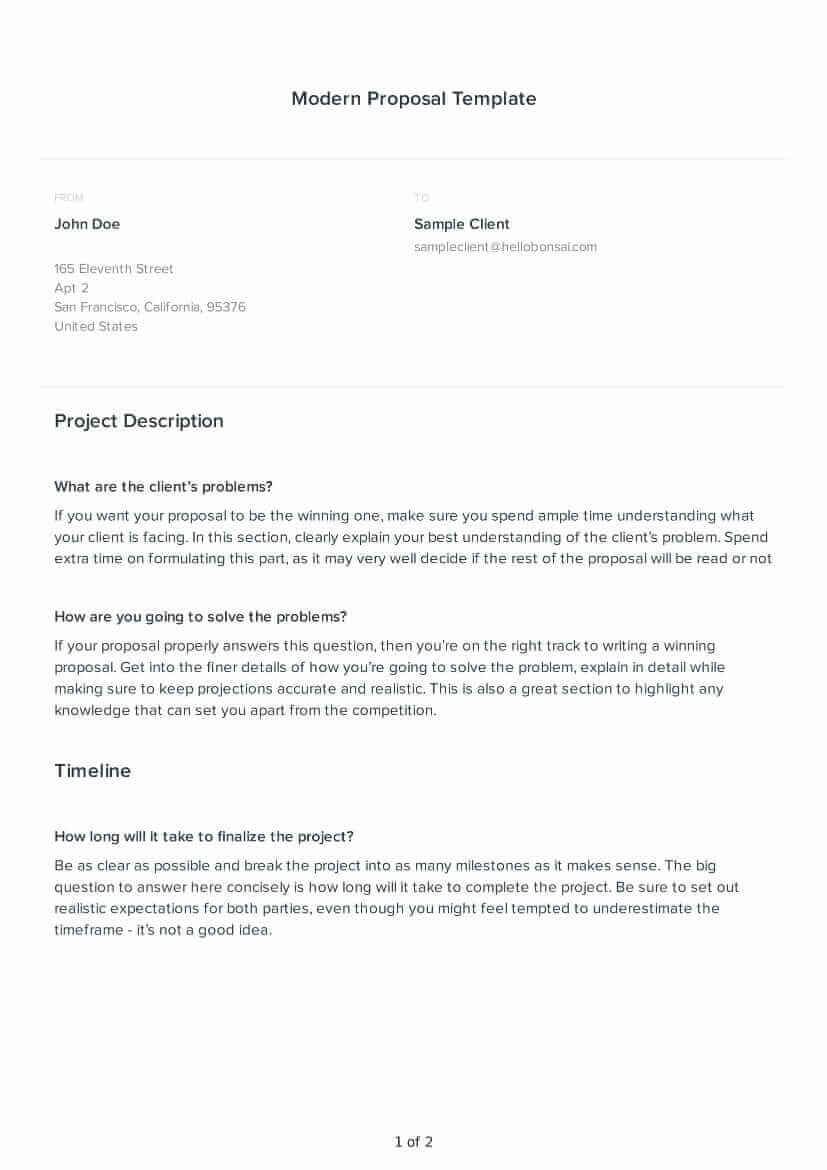
In this proposal template from Bonsai, you can see that the proposal identifies the problem that the client has.
The proposal offers several solutions to the problem in one package. The writing includes steps in the plan of action.
The proposal also includes a timeline for these steps to create value for the prospect.
The writing also covers the sender's qualifications to show the customer that they are capable of handling the job.
Finally, the writing includes the sender's contact information. This makes it easier for the prospect to accept the proposal and the included services.
This winning proposal will start a business relationship with the prospect and lead to more business between the two in the future.
Need to create a business proposal fast? Use Bonsai's proposal templates to quickly create professional proposals. You can send these to prospects to get accepted and paid faster. Click here to start free now!


'%3e%3cg id='Final-Copy-2_2_' transform='translate(1275.000000, 200.000000)'%3e%3cpath class='st0' d='M7.4,12.8h6.8l3.1-11.6H7.4C4.2,1.2,1.6,3.8,1.6,7S4.2,12.8,7.4,12.8z'/%3e%3c/g%3e%3c/g%3e%3c/g%3e%3cg id='final---dec.11-2020'%3e%3cg id='_x30_208-our-toggle' transform='translate(-1275.000000, -200.000000)'%3e%3cg id='Final-Copy-2' transform='translate(1275.000000, 200.000000)'%3e%3cpath class='st1' d='M22.6,0H7.4c-3.9,0-7,3.1-7,7s3.1,7,7,7h15.2c3.9,0,7-3.1,7-7S26.4,0,22.6,0z M1.6,7c0-3.2,2.6-5.8,5.8-5.8 h9.9l-3.1,11.6H7.4C4.2,12.8,1.6,10.2,1.6,7z'/%3e%3cpath id='x' class='st2' d='M24.6,4c0.2,0.2,0.2,0.6,0,0.8l0,0L22.5,7l2.2,2.2c0.2,0.2,0.2,0.6,0,0.8c-0.2,0.2-0.6,0.2-0.8,0 l0,0l-2.2-2.2L19.5,10c-0.2,0.2-0.6,0.2-0.8,0c-0.2-0.2-0.2-0.6,0-0.8l0,0L20.8,7l-2.2-2.2c-0.2-0.2-0.2-0.6,0-0.8 c0.2-0.2,0.6-0.2,0.8,0l0,0l2.2,2.2L23.8,4C24,3.8,24.4,3.8,24.6,4z'/%3e%3cpath id='y' class='st3' d='M12.7,4.1c0.2,0.2,0.3,0.6,0.1,0.8l0,0L8.6,9.8C8.5,9.9,8.4,10,8.3,10c-0.2,0.1-0.5,0.1-0.7-0.1l0,0 L5.4,7.7c-0.2-0.2-0.2-0.6,0-0.8c0.2-0.2,0.6-0.2,0.8,0l0,0L8,8.6l3.8-4.5C12,3.9,12.4,3.9,12.7,4.1z'/%3e%3c/g%3e%3c/g%3e%3c/g%3e%3c/g%3e%3c/svg%3e)