




.webp)

.webp)
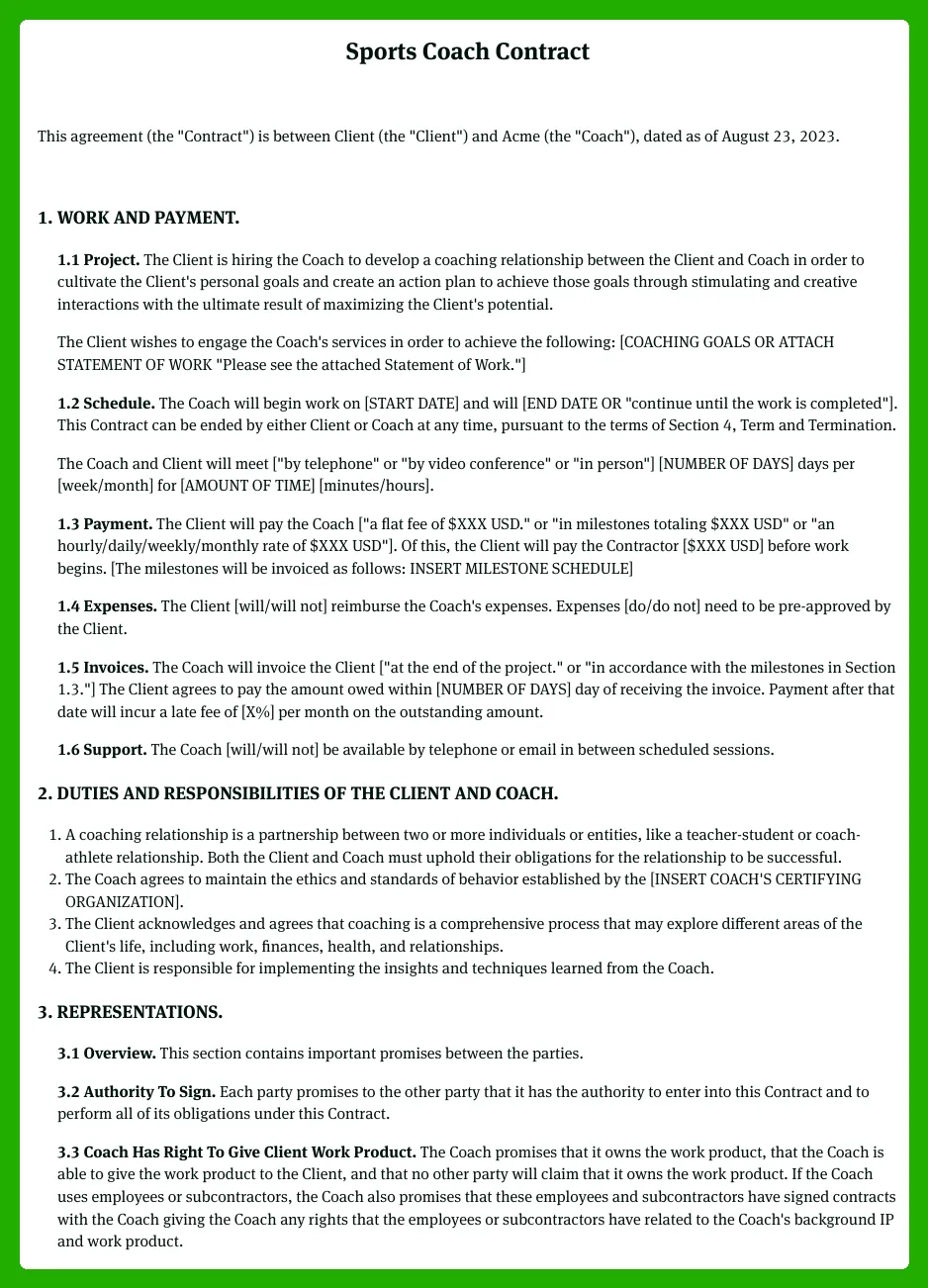
What is a sports coach contract template?
A sports coach contract template is a ready-to-use legal framework that coaches, coaching businesses, and sports organizations can customize for each engagement. It clearly defines the services provided, the duration of the coaching relationship, how the coach is compensated, and other key terms so every engagement starts with the same clear expectations.
Using this template helps you avoid rewriting terms from scratch for every athlete, team, or program. It supports different athletes, teams, or programs by letting you tailor age groups, competition levels, venues, and local requirements while keeping a solid core structure. This consistency makes onboarding smoother, simplifies invoicing, and strengthens risk management for freelance coaches, clubs, academies, and schools in 2026 and beyond.
Definition and purpose
A sports coach contract template is a pre-drafted agreement between a coach (or coaching business) and a client, athlete, team, club, or school. It outlines the services, time period, compensation, and key terms, so every engagement is documented consistently and professionally.
By using this standard template, coaches save time and reduce back-and-forth since the same core terms can be reused with minor tweaks. The document is versatile enough for individual athletes, small-group sessions, or longer development programs, and it can be updated to reflect age, level, and venue. In 2026, digital signatures and secure storage also help keep records compliant and easy to renew or adjust, which many programs rely on today.
Who uses a sports coach contract
The main users are freelance sports coaches, personal trainers with athletic clients, coaching companies, clubs, academies, and schools that hire external coaches.
Templates cover contracts for individual athletes, small groups, teams, and long-term athletic development programs. For example, a track club might use a single master template that is personalized per athlete, while a school might use separate athlete addenda for minors with guardian consent. In 2026, more organizations rely on templates to scale coaching services without losing clarity or control over terms.
How a template supports athlete contracts
The same core structure can be adapted whether the client is an individual athlete, a parent or guardian signing for a minor, or a professional club contracting a coach.
Using one template across multiple athletes creates consistency and makes renewals faster. It also helps with onboarding new athletes, tracking progress, and maintaining up-to-date health disclosures and insurance requirements. This approach reduces gaps in terms, such as scope, schedule, or payment, and keeps the coaching business organized as it grows.
Key components of a coach–athlete agreement
The backbone of any coach–athlete contract is a set of core sections that appear in nearly every agreement.
The following sections are typically included in almost every coach–athlete agreement to define roles, responsibilities, and protections for both sides.
- Parties and contact details
- Scope of coaching services
- Schedule and time period
- Location and facilities
- Compensation and expenses
- Rules and code of conduct
- Health and medical disclosures
- Liability and insurance
- Termination
- Governing law
Core clauses to include in a sports coach contract template
When you create a Sports Coach Contract Template, certain clauses are non-negotiable. This guide breaks down each clause, showing what it should cover, why it matters, and practical drafting tips to keep the agreement clear and enforceable.
Parties and relationship of the coach and client
Identify all parties by legal names and roles, and clarify whether the coach is an independent contractor or an employee.
In this clause, list the coach or coaching company and the athlete, parent/guardian, team, club, or school as the Client. Include the coach’s full legal name, the organization’s legal name if applicable, and the coach’s role (head coach, assistant coach, trainer). Clearly state whether the coach is an independent contractor or an employee, since this distinction affects taxes, benefits, and liability coverage. For example, an independent contractor generally handles self-employment taxes and does not receive employee benefits, while an employee would have payroll deductions and workers’ compensation coverage.
Drafting tip: define terms like “Coach” and “Client” at the top and reference them throughout. Use the exact legal names to avoid confusion (e.g., “ABC Athletics, LLC” as the Coach and “XYZ High School” as the Client). If the relationship could change (such as from contractor to employee), include a provision that governs the change and any tax or benefit implications. Consider consulting a lawyer when minors are involved to ensure compliance with local rules.
Scope of coaching services
This clause describes what the coach will actually do, including sport, level, sessions, and development goals.
Describe the sport and the level of athletes, the approximate number of sessions, whether it’s group or one-on-one, and whether the program runs in-season, off-season, or both. Include any specific development goals, milestones, or measurable targets, and spell out what is not included (for example, medical treatment or guaranteed team selection). Setting these boundaries helps manage expectations and reduces disputes if results take longer than planned.
Drafting tip: specify a typical schedule or session length (for example, 60 minutes) and how progress will be tracked (brief notes or reports). Tie the scope to compensation so both sides know what is included. If working with minors, include consent processes with guardians and any required safety training or certifications. Require written changes to scope as a “change order” if needs shift during the term.
Time period, schedule, and renewals
This clause sets the contract’s start and end dates, the regular coaching schedule, and renewal options.
State the start date and end date clearly, and list the regular schedule (days of the week and times) plus the season dates. For schools or clubs, note typical terms like one season (about 3–4 months) or one school year (roughly August through June). Decide whether the agreement auto-renews, requires written renewal, or is non-renewable, and explain how schedule changes will be handled, including notice requirements. Clear terms help both sides plan and avoid gaps in coaching coverage.
Drafting tip: use a single renewal clause to simplify updates and require written notice to renew or terminate at the end of a term. If you allow month-to-month arrangements, specify the notice period for termination or schedule changes (for example, 15–30 days). Include how changes due to holidays, tournaments, or school closures will be handled to set expectations upfront.
Location, facilities, and equipment
This clause covers where coaching sessions take place and who provides and maintains facilities and equipment.
Specify the location(s) for sessions, such as school gyms, club fields, private training centers, or public spaces. State who provides and maintains facilities and equipment and who pays for repairs or replacements. Include safety considerations like lighting, cleanliness, and equipment suitability for the athlete’s age and sport, and address weather-related cancellations or facility closures. This minimizes confusion if venues change during the term.
Drafting tip: name the party responsible for facility upkeep and safety checks, and require any necessary permits or clearances in writing. If using school facilities, reference the school’s rules and insurance requirements. Include a provision that the coach will inspect equipment before use and report hazards promptly to avoid injuries.
Compensation, expenses, and payment terms
This clause sets how the coach gets paid and how expenses are handled.
Describe the compensation structure (hourly rate, per-session fee, per-season stipend, or salary). State payment frequency (weekly, biweekly, or monthly), accepted methods (ACH, check, card), and due dates. Include any late fees and how taxes are handled. For reimbursable expenses like travel, equipment, or tournament attendance, explain what is reimbursable and the required documentation. Also spell out what happens if a session is canceled or an athlete is absent, such as credits or refunds or pay-for-not-progress policies.
Drafting tip: define “expenses” clearly and require receipts. Include a cap on reimbursable amounts and specify whether expenses are paid in advance or after the fact. If using a per-season stipend or salary, tie the amount to a defined period and note any annual adjustments. Clarify tax withholding responsibilities if the coach is an independent contractor or employee, to prevent surprises at tax time.
Cancellations, no-shows, and schedule changes
This clause spells out responsibilities for cancellations, rescheduling, and what happens when someone is late or misses a session.
Set minimum notice periods for cancellations and whether sessions can be rescheduled. State how late cancellations and no-shows are charged and under what circumstances a coach or athlete can reschedule. Providing clear policies helps protect the coach’s income and gives athletes a predictable path for changes. Include channels for communication, such as email or a contract portal, to keep records.
Drafting tip: tie the policy to the program’s calendar and season dates, and include exceptions for weather, safety concerns, and emergencies. Consider offering make-up sessions for a reasonable window if both sides agree. Also ensure the clause works with other sections, such as the refund policy and schedule.
Code of conduct and ethical standards
This clause sets behavioral expectations for coach and athletes.
Describe the expected conduct, including respect, sportsmanship, anti-harassment and anti-discrimination, and adherence to school, club, or league rules. Note that many athletic bodies have codes of conduct you should link or summarize. This section protects minors, supports safe environments, and helps enforce rules if behavior is not appropriate. Be clear about reporting channels and consequences for violations.
Drafting tip: reference external codes and bylaws and keep a short summary in the contract with a link to the full document. Include a process for reporting concerns, investigations, and disciplinary actions. Also set expectations for maintaining professional boundaries, communication standards, and responsible use of equipment and facilities.
Health disclosures, medical checks, and safety
This clause covers health information and safety protocols.
Require guardians or athletes to disclose relevant medical conditions and emergencies. State that sports carry inherent risks and that the coach is not a medical professional. Some programs require safeguarding protocols and background checks for the coach, plus CPR/First Aid certification. Include provisions for safeguarding youth athletes, emergency contact information, and a plan for dealing with medical incidents during training or events.
Drafting tip: specify who can make medical decisions in an emergency, how information is stored, and how often medical information is updated. Include a clause that the coach will not administer prescription medications beyond first aid unless properly trained. For high-risk activities, outline safeguarding procedures and the required background checks or clearances.
Rules, bylaws, and governing policies
This clause references rules from applicable organizations.
This clause requires adherence to the rules and bylaws of schools, clubs, leagues, and governing bodies that apply to the contract.
Reference the external rules your athletes and coaches must follow, and explain how violations will be handled. Include discipline, termination, or other remedies if rules are violated. By tying the contract to those rules, you can justify actions if behavior or performance breaches occur. Also note any updates during the term and how they will be communicated.
Drafting tip: include exact names of the governing bodies and provide a link or citation to the current codes. Add a clause that changes to rules automatically apply to ongoing contracts after a reasonable notice period. Keep the language straightforward so both parties know what is expected and what can trigger consequences.
Liability, indemnification, and insurance
This clause allocates risk between the coach and client, with clear language on liability, indemnification, and insurance requirements.
Include an explicit assume-risk statement for athletes, plus limitations on the coach’s liability and indemnification obligations if one party’s actions cause losses. Also clarify what insurance each party carries or must carry (coach, club, or school), and whether the contract requires the other party to be named as an insured. This helps set expectations and reduces exposure in case of accidents or claims.
Drafting tip: specify limits (for example, liability capped at the amount of fees paid in the last 12 months, or excluding certain types of damages), require certificates of insurance, and name additional insureds if needed. Note that waivers or releases for minors should be reviewed by a lawyer, and ensure the clause complies with local law and safety requirements.
Termination and non-renewal of the agreement
This clause explains how and when the contract ends.
Cover termination for cause (misconduct, non-payment, rule violations) and for convenience (with notice). Explain what happens to outstanding payments and prepaid sessions if the agreement ends early, and how unused sessions are handled. You can also state whether the contract auto-renews and how to terminate renewal terms. Clear terms prevent disputes if the relationship ends mid-season or mid-year.
Drafting tip: include post-termination obligations, such as return of equipment and confidential information, and state what happens to deposits and credits. If applicable, mention non-solicitation or non-poaching restrictions and how they interact with school or club policies. Keep termination clauses simple and enforceable by specifying notice periods and a straightforward process.
Dispute resolution and governing law
This clause explains how disputes will be resolved and which law governs the contract.
Outline the steps for resolving disputes, starting with informal discussion, then mediation, arbitration, or court action. State the chosen jurisdiction or venue and the governing law, and keep language simple so both coach and client understand the process. Also mention whether any mediation or arbitration must be completed before court action.
Drafting tip: include clear timelines for each step, select a single governing law, and specify who bears costs if a dispute occurs. Consider adding a clause that the prevailing party in any dispute can recover reasonable attorneys’ fees. Ensure the clause complies with local laws and is clear enough for schools, clubs, and individual athletes to understand.
How to adapt a sports coach contract template for different coaching scenarios
A single, well-structured Sports Coach Contract Template can be customized for private athletes, teams, schools, and clinics. By understanding which sections typically change and which legal elements stay intact, you can move quickly between scenarios while staying compliant in 2026. The goal is clarity, predictable payments, and documented expectations for all parties involved.
To tailor contracts for individual athletes and families
When the client is a single athlete (or their parent or guardian), start by adjusting the scope of services, schedule, and goals. Define exactly what’s included, where training happens, and how many sessions are available. For example, offer two 60-minute sessions per week over 12 weeks, with a clear start and end date.
Next, add parental consent and clear communication rules. Include emergency contacts and a medical release clause, plus how progress is shared (monthly notes via a secure portal). Consider a separate privacy rider for photos or video use, and specify how and when the athlete’s data may be used or shared.
Finally, ensure the contract can be signed by a parent or guardian using e-sign tools such as DocuSign or HelloSign, which provide tamper-evident records. Set expectations for response times and any boundaries around messaging after hours to protect everyone’s time and safety.
To structure agreements for teams, clubs, and academies
For teams, clubs, or academies, you shift from a single-client focus to group obligations and organizational alignment. Specify the number of athletes, session frequency, locations, and how attendance is tracked, while noting how coaching duties integrate with existing staff schedules.
Describe group training obligations, scheduling coordination with the organization’s staff, and any team selection policies or tryout procedures. Align the contract with the organization’s bylaws and code of conduct to avoid conflicts, and include clear expectations about equipment, uniforms, and safety protocols.
Include a framework for communication and dispute resolution within the group, plus risk management clauses that reflect the organization’s insurance policies. This keeps the contract robust without micromanaging individual interactions, while making sure everyone understands roles, reporting lines, and escalation paths.
To align contracts with school and league requirements
When coaching in schools or leagues, anchor the template to school district policies and athletic association rules. Reference the specific district or league handbook and ensure your terms do not contradict existing employment or volunteer agreements. This alignment helps prevent conflicts during the academic year and sports seasons.
Incorporate required background checks, certifications, or training as mandated by the district or league, such as CPR/First Aid, concussion training, and state-specific coaching credentials. Document these requirements with clear deadlines and renewal needs, and specify how verification will be shared with the school or league administrators.
Clarify reporting structures and supervision to avoid overlap with school staff. Include expectations around campus time, eligibility rules, and any interaction with booster clubs or parent organizations, so the contract supports school policies rather than duplicating them.
To adjust terms for short-term clinics and long-term programs
Use the same Sports Coach Contract Template for one-off camps, clinics, or workshops and for season-long or year-round training by adjusting the time frame and payment structure. Start with a defined start date, end date, and a clear description of the program’s scope to prevent scope creep.
Highlight which clauses change most—time period, compensation structure, and cancellation rules—and how to state whether the contract ends automatically or may be extended. For clinics, consider a per-session or per-week payment model with a fixed cap on total hours; for long-term programs, use a monthly retainer or a bundled package with milestones and progress checks.
Finally, include a straightforward renewal or extension process. If extensions are possible, attach an addendum with updated terms, schedules, and fees. As a practical tip, use e-sign tools like DocuSign to capture continued consent, and keep both parties on the same page with a centralized calendar and document hub.
Legal and compliance considerations for athletic coach contracts
Starting from a Sports Coach Contract Template gives you a solid structure for recruiting, operating, and safeguarding athletes. But in 2026, rules vary by state, league, and school policy. This section highlights the main legal issues coaches and organizations should keep in mind when using the template. Remember: a template is a starting point, not a final contract, and customization is essential to stay compliant with local laws, safeguarding requirements, and organizational rules.
To comply with safeguarding and background check requirements
Safeguarding minors and vulnerable athletes requires clear checks and rules in the contract.
For background checks, define onboarding requirements, who runs them, and how results affect eligibility. The contract should specify that a current background check is required before starting, with checks conducted by the organization or an approved provider such as Checkr or Sterling. Checks should cover criminal history and access to child abuse registries; if the role includes transporting athletes, driving history may also be reviewed. Results should be reviewed by a designated safeguarding officer, and unsatisfactory findings should bar the coach from interacting with minors until cleared. In practice, many leagues require re-checks every 1-3 years, and the contract should spell out who pays for these checks and how records are stored securely. The policy should also cover mandatory reporting obligations and how concerns are escalated within the organization.
In addition to checks, include supervision rules and mandatory reporting obligations. The contract should require coaches to report safeguarding concerns to the designated officer and follow local reporting laws, with clear steps for documentation and escalation. It should outline who is responsible for notifying parents or guardians and how investigations will be handled, along with any required safeguarding training and ongoing compliance expectations. Finally, specify consequences for non-compliance, such as suspension or reallocation to non-minor activities until issues are resolved.
To handle data protection and confidentiality
Athlete data, health information, and performance data deserve strong protection and clear handling rules in the contract.
The contract should designate who acts as the data controller and set rules for data minimization, retention, and secure storage. Include a retention period appropriate to your jurisdiction and program type (commonly 2–7 years after last participation), plus requirements for encryption, access controls, and secure transfer of information. It should also spell out how data is protected when stored by the organization, coach, or third-party vendors, and outline breach notification procedures in line with local laws. Explicitly define roles and responsibilities for data security, training requirements, and periodic reviews to keep practices up to date.
Regarding sharing, specify when information can be shared and with whom. The contract should require written consent to disclose personal data, health details, or performance information to parents, schools, medical providers, or league officials, with limited, need-to-know access. It should also describe emergency sharing provisions, such as sharing essential health information during an injury or medical event, and outline any required notices to guardians or athletes when data is shared.
To respect intellectual property and use of likeness
Training materials, drills, videos, and branding created by the coach are valuable assets that deserve clear handling rules in the contract.
The writer should clarify ownership of training materials, drills, videos, and branding. Generally, the coach retains ownership of their original materials, while the organization receives a non-exclusive, revocable license to use those materials for program purposes during the contract term. Define whether the license extends to continued use after the contract ends and under what conditions it can be renewed. Include explicit terms about how branding and logos can be used in connection with the program and what happens if the coach wants to change or revoke access to materials. This helps prevent disputes over rights and ensures everyone understands the licensing scope.
For photos and videos of athletes, include clear consent and usage limits. The contract should specify that the coach may capture or receive footage for training and safety purposes, but athlete likeness for marketing or social media requires separate consent with defined scope and time limits. Outline where the material may appear (website, social channels, brochures) and how guardians can withdraw consent. By setting these boundaries, you reduce risk and protect both the athletes and the program’s reputation.
To seek legal review before finalizing
Treat the template as a strong starting point, but always seek legal advice to tailor it to the jurisdiction, sport, and age group involved.
Legal review is especially important in professional or school-based environments, where additional statutory requirements may apply. Engage a licensed attorney with sports or contract law experience to review the document, confirm alignment with local safeguarding rules, data privacy laws, and league policies, and suggest jurisdiction-specific amendments. If you work with schools or clubs, consider coordinating a review through the district or association counsel to ensure compliance across all stakeholders. Planning this review early—ideally 3–4 weeks before signing—helps prevent delays and costly revisions later.
To prepare for a legal review, assemble all relevant materials: the current template, league rules, safeguarding guidelines, data privacy notices, and any related policies. Provide the reviewer with a checklist of concerns and a list of programs where the contract will be used. This approach makes the process smoother and increases the likelihood of a clean, enforceable agreement that protects coaches, athletes, and organizations alike.
How to use a sports coach contract template effectively
Using a sports coach contract template effectively helps you protect your business, clarify roles, and keep engagements running smoothly. In 2026, it’s common practice to customize contracts for each athlete or organization, set clear expectations upfront, collect signed documents electronically, and continually improve the template based on real-world feedback. The sections below offer practical steps you can implement today.
To customize the template for each engagement
Start from your standard sports coach contract template and tailor the variable details for each engagement.
Begin by keeping the core legal structure intact—definitions, payment terms, governing law, and liability limits—while updating variable fields: client names, engagement dates, hourly rate or per-session fee, session cadence, and sport-specific requirements such as uniforms, safety gear, or field permissions. For example, a private basketball session for a club team might specify the coach as an independent contractor, a season from September 1 to June 30, a $70 per-hour rate, three 90-minute practices per week, and waivers for gym access and equipment usage.
Next, fine-tune the scope of services and rules for each athlete or organization. Define service formats (one-on-one, small group, clinics), the exact schedule, cancellation terms, equipment responsibilities, and safety expectations. Use version control so the team can see changes, and name the file with a version number, such as SportsCoaches_Template_v2.4. Starting with a consistent core helps keep enforceability while allowing you to address unique needs efficiently.
To set expectations before training begins
Set expectations before training begins by following a simple workflow that both sides can follow.
Describe a simple workflow: share the draft contract with the athlete, parent, or organization; walk through key clauses (services, compensation, cancellations, conduct); and only start coaching once both sides have agreed and signed. This reduces misunderstandings and builds trust from day one. For example, set a 3- to 5-business-day window for review, and plan a 15- to 30-minute call to clarify any questions before signing.
Then reiterate the practical steps: confirm the agreed-upon schedule, payment terms, and expectations for behavior and safety. By documenting these details upfront, you create a reliable framework that guides interactions, minimizes last-minute changes, and keeps both sides aligned as training begins.
To obtain signatures and store signed contracts
Electronic signatures speed up the process and make records easier to manage.
Guide the reader to use electronic signatures for speed and clarity. Explain why it’s important to keep all signed sports and athlete contracts in a single, organized system—so they can quickly confirm terms, respond to disputes, or prove what was agreed if needed. Use widely trusted platforms like DocuSign, Adobe Sign, or HelloSign, and ensure every copy includes an auditable signing history.
Store the signed contracts in a centralized location with clear naming and tagging. Create a folder structure by client and year, and include the contract, amendments, waivers, and any related correspondence. A simple naming convention (ClientName_EngagementYear_Version.pdf) keeps terms easy to locate during a dispute or audit.
To update and improve the template over time
Regular evaluation helps you keep the template relevant and protective.
Encourage coaches to review their template periodically based on real-world issues they encounter: payment disputes, schedule conflicts, conduct problems, or safety incidents. Suggest adding or refining clauses in the sports coach contract template so that each new engagement is better protected than the last. For example, after a dispute about late payments, you might add a clear late-fee policy and a documentation requirement for payment reminders.
Implement a simple change-log and versioning process. Record what changed, why it changed, and who approved it. Keep archived copies of older versions for reference, and test updates with a couple of engagements before broad rollout. This approach helps you gradually improve protection and clarity across all future contracts.
How Bonsai helps manage sports coach contract templates
Bonsai is the central hub for creating, sending, and managing all your sports coaching and athlete contracts. It turns static templates into dynamic workflows that save time, reduce errors, and keep every coaching agreement organized and accessible. With master templates, version control, and built-in e-signature, you can scale from coaching a single athlete to running a full program with multiple teams or schools, always having the latest terms ready to edit and reuse.
To create reusable sports coach contract templates
Set up a master sports coach contract inside Bonsai with standard clauses for scope, compensation, conduct, and liability.
Start by drafting a master contract that clearly defines service scope (number of sessions, travel expectations, equipment), compensation terms (per-session rate, retainer, or milestone payments), conduct guidelines, risk and liability waivers, and confidentiality where appropriate. Then save multiple versions for different sports or client types—individual athletes, small teams, and school partnerships—and reuse them with a few quick edits. In Bonsai, you can tag each version by sport and client type, making it fast to find the right baseline when you need it.
This versioning makes it fast to customize for a new season or athlete. You can clone an existing version, tweak the sport type, adjust the number of sessions, and update travel or equipment clauses in under a minute. When you save these as templates, Bonsai automatically tags them by sport and client type so you can pull the right one with a single search.
To track and manage sports coach contracts in one place
Bonsai lets coaches see every contract’s status at a glance—Draft, Sent, Viewed, Signed—and link each agreement to the relevant client or athlete profile.
This centralization makes it easy to pull up terms for any coaching contract, share them with team staff, and keep everyone aligned on timelines. Each contract can be attached to the athlete’s profile, with linked notes, related invoices, and payment schedules. When terms change, Bonsai preserves contract history, so you can review revisions without digging through emails or chat messages.
In practice, you can filter by sport, season, or coach, and export a contract summary to share with an administrator or athletic director, keeping renewals and approvals on track.
To automate approvals, reminders, and follow-up
Automation keeps approvals, reminders, and follow-up flowing without extra clicks, so you stay on schedule with minimal admin time.
The following automations help you move from contract to scheduling without extra steps:
- Sending contracts for e-signature with automatic reminders if they’re unopened or unsigned
- Notifying you when an athlete or organization has signed so you can schedule sessions immediately
- Triggering welcome emails or intake forms after a contract is fully executed
- Linking signed contracts to projects, invoices, and payment schedules so your athletic coaching workflow stays in sync
With these automations, you can cut admin time by 40-60% per contract cycle, ensure athletes sign on time, and keep your projects, invoices, and payment schedules in sync with your coaching calendar.


'%3e%3cg id='Final-Copy-2_2_' transform='translate(1275.000000, 200.000000)'%3e%3cpath class='st0' d='M7.4,12.8h6.8l3.1-11.6H7.4C4.2,1.2,1.6,3.8,1.6,7S4.2,12.8,7.4,12.8z'/%3e%3c/g%3e%3c/g%3e%3c/g%3e%3cg id='final---dec.11-2020'%3e%3cg id='_x30_208-our-toggle' transform='translate(-1275.000000, -200.000000)'%3e%3cg id='Final-Copy-2' transform='translate(1275.000000, 200.000000)'%3e%3cpath class='st1' d='M22.6,0H7.4c-3.9,0-7,3.1-7,7s3.1,7,7,7h15.2c3.9,0,7-3.1,7-7S26.4,0,22.6,0z M1.6,7c0-3.2,2.6-5.8,5.8-5.8 h9.9l-3.1,11.6H7.4C4.2,12.8,1.6,10.2,1.6,7z'/%3e%3cpath id='x' class='st2' d='M24.6,4c0.2,0.2,0.2,0.6,0,0.8l0,0L22.5,7l2.2,2.2c0.2,0.2,0.2,0.6,0,0.8c-0.2,0.2-0.6,0.2-0.8,0 l0,0l-2.2-2.2L19.5,10c-0.2,0.2-0.6,0.2-0.8,0c-0.2-0.2-0.2-0.6,0-0.8l0,0L20.8,7l-2.2-2.2c-0.2-0.2-0.2-0.6,0-0.8 c0.2-0.2,0.6-0.2,0.8,0l0,0l2.2,2.2L23.8,4C24,3.8,24.4,3.8,24.6,4z'/%3e%3cpath id='y' class='st3' d='M12.7,4.1c0.2,0.2,0.3,0.6,0.1,0.8l0,0L8.6,9.8C8.5,9.9,8.4,10,8.3,10c-0.2,0.1-0.5,0.1-0.7-0.1l0,0 L5.4,7.7c-0.2-0.2-0.2-0.6,0-0.8c0.2-0.2,0.6-0.2,0.8,0l0,0L8,8.6l3.8-4.5C12,3.9,12.4,3.9,12.7,4.1z'/%3e%3c/g%3e%3c/g%3e%3c/g%3e%3c/g%3e%3c/svg%3e)