




.webp)

.webp)
What is a model contract template?
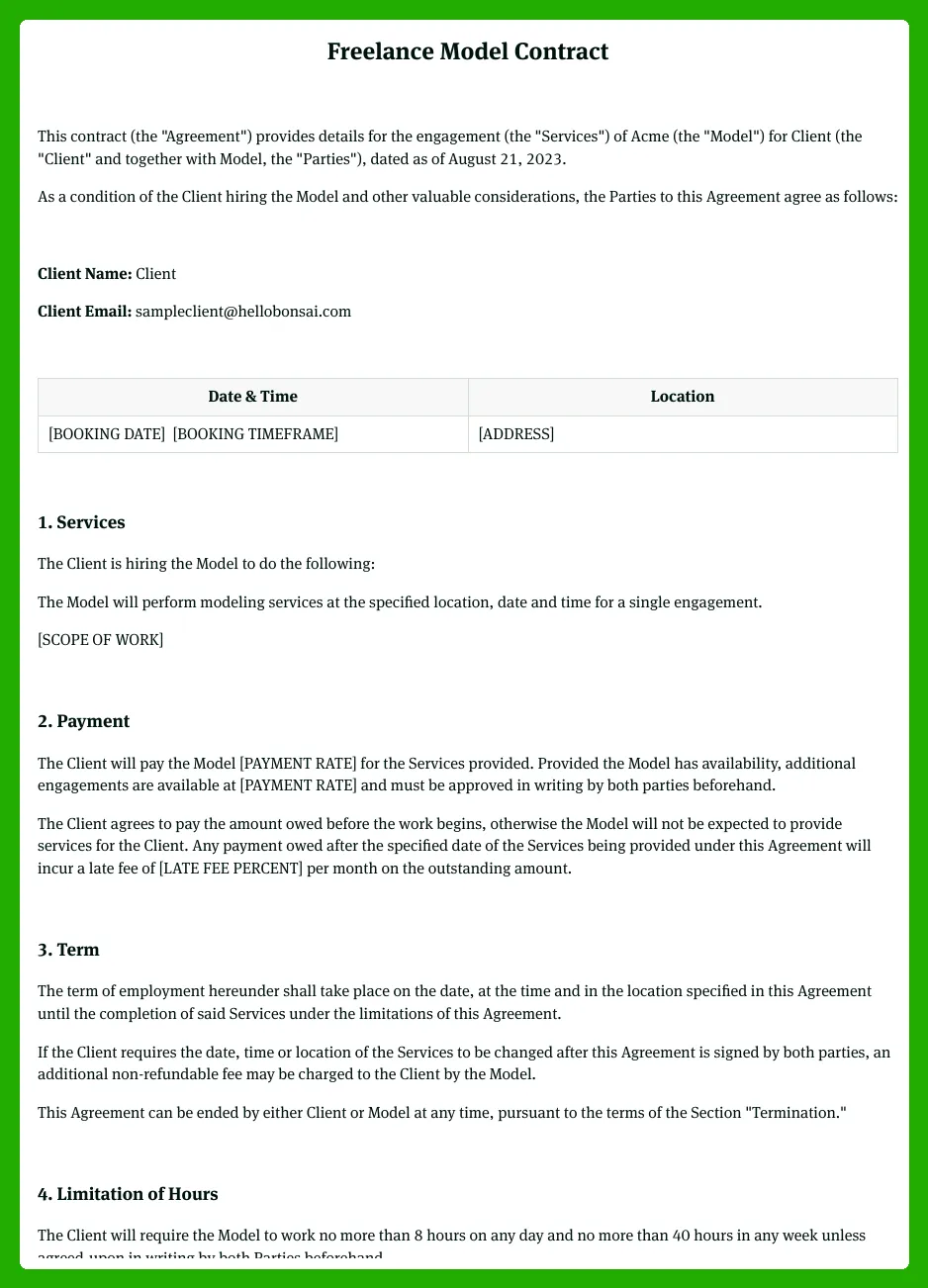
A model contract template is a practical, ready-to-use agreement that defines the legal and business relationship between the model and the hiring party. It sets out who is involved—such as an agency, brand, photographer, or client—and how the work will be paid and protected. A reusable template creates a standardized framework that you can customize for each job, helping both sides stay aligned while saving time.
Definition and purpose
A model contract template is a pre-drafted agreement that clearly outlines who does what, who owns the images, how much is paid, and what protections apply.
It covers roles and responsibilities for both model and client, defines image rights (who can use the photos, where they can appear, and for how long), and includes payment terms and liability limits. The contract also spells out performance expectations, wardrobe and makeup responsibilities, and any required releases. It typically includes clauses on confidentiality and moral rights where applicable, plus cancellation and rescheduling rules. By listing these items in one place, everyone knows what to expect before the shoot starts.
Because you can adapt it for different use cases—agency contracts, a one-off fashion shoot, or long-term representation—the template provides a common starting point. You can tailor the scope of work, usage rights, exclusivity, and renewal terms to fit a specific job. This standard framework helps prevent miscommunication, speeds up negotiations, and makes it easier to share the agreement with lawyers if needed. In practice, many studios customize a base template in under 30 minutes using Word or Google Docs. As of 2026, digital signing with DocuSign, Adobe Sign, or HelloSign is widely accepted, making final approvals fast and paperless.
When to use a model contract
A model contract is used to set clear expectations before work begins in standard modeling scenarios.
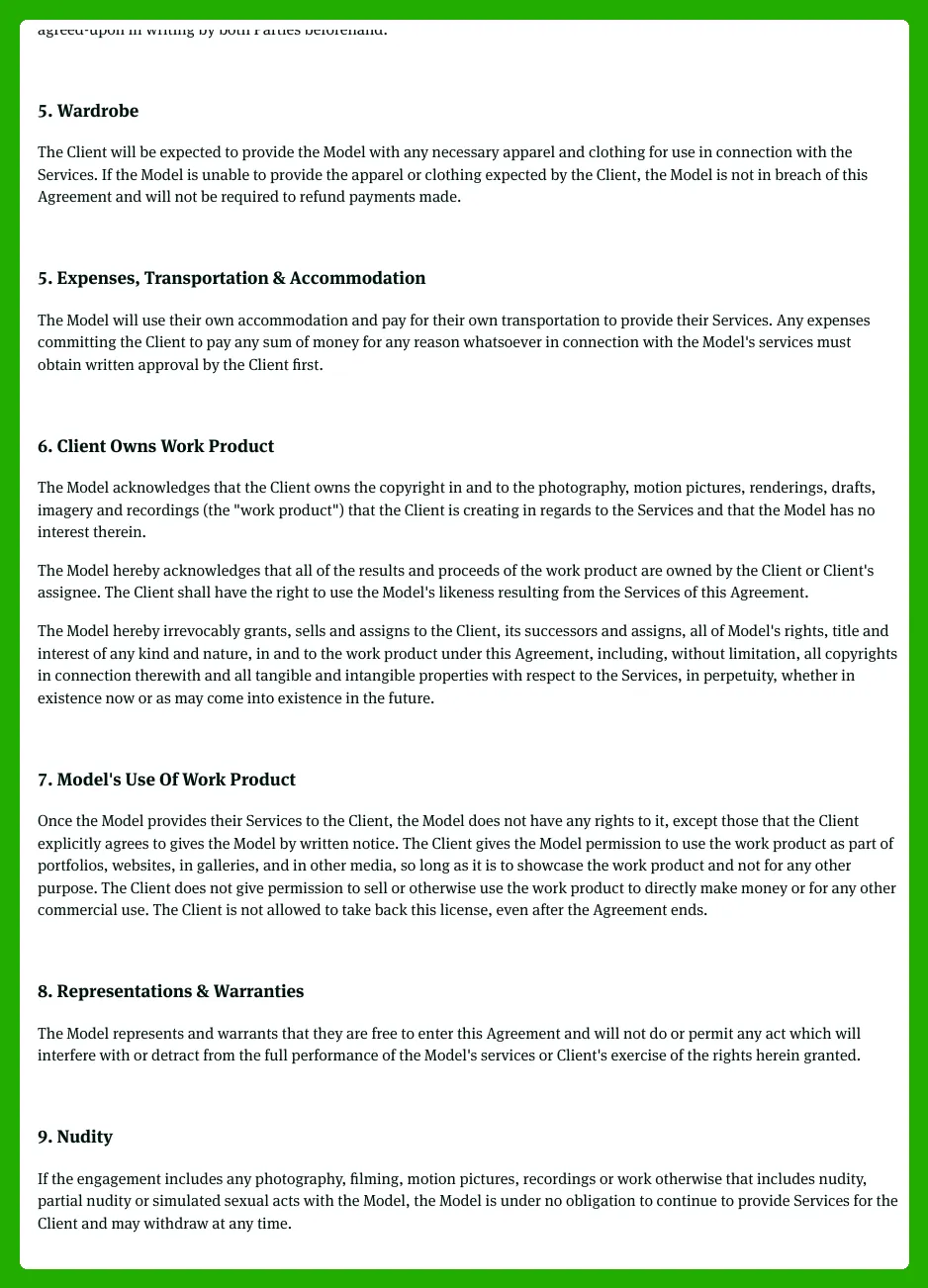
Examples include signing with a modeling agency to formalize representation; hiring a freelance model for a campaign or a fashion shoot; booking models for events like fashion shows or trade shows; or working with online or remote modeling arrangements. The contract helps set a basic schedule, deliverables, and payment terms, and it can specify travel, wardrobe, and shoot location requirements.
A contract should be in place whenever a model’s likeness, time, or services are used professionally. This covers paid campaigns, social media posts, livestreams, runway appearances, or virtual fittings. It’s also useful for multi-day shoots or international travel. To speed approvals, many teams now use e-sign tools such as DocuSign, Adobe Sign, or HelloSign so everyone can sign from anywhere in minutes.
Who uses model contract templates
These templates are used by several groups to formalize terms and avoid confusion on every project.
The main users are:
- Modeling agencies formalizing representation
- Freelance models securing fair terms
- Brands and production companies hiring talent
- Photographers and creatives organizing shoots
- Small businesses or creators needing clear agreements for promotional content
Using templates helps ensure fair terms, protect rights, and streamline production for both sides. They provide a clear baseline for rights, schedules, and payments across agencies, models, brands, photographers, and small businesses, making collaborations smoother and more professional.
Core parties and contract structure
Clear party identification and a well-structured layout are the backbone of any Model Contract Template. In 2026, contracts that name everyone clearly and spell out the relationship from day one reduce disputes when changes happen later. This section shows how to identify who is involved, what kind of relationship exists (agency vs. direct client), and how long the agreement lasts.
Identify the parties
Open by naming and defining each party: the model as an individual, the agency (if any), and the client or hiring company. Include the legal names, the business forms, and current contact information so notices land in the right place.
In practice, you might list the Model as Jane A. Doe, an individual; the Agency as XYZ Management LLC, a limited liability company; and the Client as Acme Productions, Inc., a corporation. Add clear contact details for each party, including email, phone, and a physical address for notices. This template should support both an agency–model setup and a direct client–model setup, so use a flexible party matrix or rider to indicate which entities are signing and who represents whom. HelloBonsai’s Model Contract Template commonly uses a single master agreement with riders to cover either configuration.
Define the contract type and scope
State the contract type clearly—whether this is ongoing representation, a project-specific booking, or a one-time shoot—and include a brief description of the purpose (runway shows, print campaigns, social media content, brand events) to frame all later clauses.
Next, describe the scope by outlining the services, deliverables, timeline, and any exclusivity or territory considerations. For example, specify how many shoots are included per year, the scheduled call times, and the expected usage rights (print, web, social, and rights granted in perpetuity or for a defined period). Keep the language concrete and predictable so both sides know what’s included and what isn’t, and ensure the scope aligns with the client’s brand guidelines and the model’s availability. In a flexible template, tie the scope back to the contract type so a single document can cover a runway contract, a catalog shoot, or a social-media campaign.
Set the contract duration and timeline
Draft a term clause that specifies a start date, an end date (or that the agreement runs indefinitely until terminated), and any milestones that matter for both sides. For most agency relationships, the term is a fixed period that can auto-renew unless notice is given.
For shoot-based contracts, include specific dates such as the shoot date, call times, and a delivery or publication window. Also state when the agreement becomes effective, typically upon signature, and outline renewal or termination notice requirements (for example, notice of non-renewal 30–60 days before the term ends). This approach gives both the model and the client a predictable timeline and helps schedule bookings, approvals, and asset delivery without last-minute changes. A 2026 best practice is to document all milestones and keep the timeline aligned with the project calendar in HelloBonsai templates.
Key components of a model agreement template
This section outlines the essential components you should include in a Model Contract Template. It provides a checklist-style overview of scope of work, release and usage rights, compensation, professional conduct, insurance, and confidentiality to prevent disputes and set clear expectations. Use this as a starting point before deeper guidance in later sections.
Scope of work and work responsibilities
This part defines what the model will do, for how long, and under what conditions.
Clearly describe the type of modeling involved—runway, editorial, commercial, or event work—and specify the expected duration, such as a 1-day shoot (8 hours) or a 3-day lookbook shoot (24 hours total). Include call times, expected fittings, rehearsals, and any travel, noting how many days and hours will be required and whether overtime applies. For example, a catalog shoot may run 8 hours with a 2-hour fitting on the same day, followed by a 1-hour rehearsal for a group shot the next day.
In addition, spell out on-set responsibilities and behavior to keep everyone aligned. Address preparation requirements like wardrobe, hair, and makeup; indicate who provides items, who covers costs for alterations, and whether the model must bring specific garments or touch-up kits. Clarify any restrictions on handling wardrobe during shoots and the expected etiquette with photographers, stylists, and crew to minimize miscommunications on set.
Scope of release and usage rights
This clause explains how the client may use the model’s images, where, for how long, and on which platforms.
Define media types covered (print, digital, social, broadcast) and specify the territories (local, national, worldwide) as well as the license duration. A common approach is a non-exclusive, worldwide license for 12–24 months, with digital and social rights included across campaigns, websites, and e-commerce. If a campaign runs across multiple channels, spell out whether each channel requires separate permission and whether sublicensing is allowed to partners or affiliates.
Be explicit about any limitations, such as prohibitions on misleading or inaccurate representations, and state how new uses will be approved. Include a process for obtaining written consent for any additional platforms or extended usage beyond the original term, so future campaigns don’t surprise the model. This section is crucial to prevent disputes about where and how the model’s image appears and to maintain control over brand alignment.
Compensation, agency compensation, and taxes
This part covers how the model gets paid, how agencies earn their share, and who handles taxes.
List base fees and day rates, along with any additional payments for usage beyond the base shoot, such as usage fees, overtime (typically 1.5x after 8 hours), or holiday premiums. For example, a 1-day shoot at $1,000 base may include a $150 overtime premium if the shoot goes past 8 hours. Include bonuses for accelerated timelines or performance milestones to incentivize reliable delivery and quality work.
If an agency is involved, specify the commission rate and how it’s calculated. A typical agency commission ranges from 15% to 20% of gross pay, so if the base pay is $1,000, the model net is $800–$850 after the agency takes its cut, depending on the agreed percentage. Clarify payment terms (net 15 or net 30) and accepted methods (direct deposit or check), and state whether rates are inclusive or exclusive of taxes. Finally, outline tax responsibilities, noting whether the model is treated as an independent contractor and who files and pays self-employment taxes, with a reminder to collect a Tax ID where required.
Professional conduct and workplace relationships
This section ensures professional behavior and safe, respectful workplace dynamics.
Outline expectations around punctuality, compliance with instructions, professionalism on set, and respectful interactions with all crew members. Establish clear boundaries to protect everyone, including policies on harassment and inappropriate behavior, and note how complaints should be reported and handled. Mention that the model must follow the client’s or agency’s anti-harassment policies and retain records of incident reporting for accountability and safety.
Consider addressing relationships in the workplace, such as policies on dating or romantic relations among staff to prevent conflicts of interest or power imbalances. Include consequences for violations and steps for resolution, such as mediation or suspension of duties, to reinforce a respectful environment and reduce risk for all parties involved.
Insurance, liability, and indemnification
This section explains who bears risk for accidents, injuries, or property damage and what insurance is required.
State who is responsible for injuries or property damage during the shoot and whether the model has insurance coverage. Many productions require general liability insurance and a certificate of insurance naming the client and agency as additional insured parties. If the model brings equipment or props, specify whether those items are insured and who covers losses or damages. Use plain language to describe indemnification, such as: “Each party agrees to hold harmless the other from losses caused by its own acts or omissions within the scope of this agreement.”
Include practical details like whether the client provides insurance coverage for on-set incidents, what medical expenses are covered, and how to handle claims. Clarify how damages are assessed and compensated, and ensure the language is clear enough for non-lawyers to understand while remaining comprehensive for risk management purposes.
Confidentiality and non-disclosure
This clause protects unreleased campaigns and sensitive brand information.
Explain that the model and, in some cases, the client or agency, may not disclose confidential information, behind-the-scenes content, or campaign details before the approved release. Define what constitutes confidential information, such as lookbooks, shoot locations, casting notes, or product details, and specify any permissible disclosures (for example, to immediate family or legal advisors) with required precautions. Set a clear duration for the confidentiality obligation, often two to five years after the engagement, or until information becomes public knowledge through no fault of the model.
Detail consequences for breaches, such as remedies or contract termination, and provide guidance on handling press inquiries or social media posts. Encourage practical safeguards like requiring NDAs signed before work begins, using secure file sharing, and retaining signed disclosures with all contract documents to ensure everyone understands the boundaries and responsibilities from day one.
How to define roles and responsibilities
In 2026, a Model Contract Template should spell out each party’s duties in clear, concrete terms. Precise responsibilities reduce misunderstandings and make enforcement easier if something goes wrong. By outlining who does what before, during, and after bookings, you create a reliable framework that helps everyone stay aligned and act quickly when issues arise.
Model responsibilities
The model’s duties cover punctuality, cooperation, appearance, safety, and confidentiality. In practice, this means arriving on time for bookings, following reasonable direction from the client or photographer, and adhering to appearance standards described in the agreement. It also includes complying with safety instructions on set and respecting any confidential information related to the shoot or client.
To make enforcement practical, add guidance on reporting issues and keeping records. State that breaches may lead to remedies defined in the agreement, such as cancellation of a booking or withholding of payments until the issue is resolved. Use precise, observable terms rather than vague promises, so everyone knows when obligations are met or violated.
Agency responsibilities
For templates that include agencies, define the agency’s duties clearly: promoting the model, negotiating jobs, handling payments, and offering career guidance. The contract should reflect that the agency acts in the model’s best interest, seeking opportunities that suit the model’s goals and capabilities, not just the agency’s own.
Key points to emphasize are transparency around commissions and deductions and timely communication about bookings. Specify how commissions are calculated and when earnings are paid to the model, with itemized deductions listed. For example, a typical arrangement might state a 15% commission on gross pay, with payments to the model issued within 7–14 days after a job completes, and all deductions clearly itemized in a statement. Clear language about ongoing duties, such as counseling on career decisions or negotiating favorable terms, helps prevent later disputes.
Include expectations for regular reporting and accountability. The agency should provide current, accurate information about each booking, including client details, shoot date, location, and contact persons. This transparency supports trust and reduces surprises for the model, especially when schedules shift or last-minute changes occur.
Client or hiring party responsibilities
The client or hiring party should be responsible for providing clear briefs, ensuring a safe work environment, and offering agreed support such as travel, accommodation, or per diems. Clear briefs help the model understand the scope, wardrobe, poses, and timelines, which minimizes re-shoots and delays. The hiring party should also ensure a safe, inclusive workspace, with accommodations for accessibility where needed.
Paying on the agreed schedule is essential, along with timely communication of any changes to the booking. The contract should specify payment terms and the process for submitting or verifying expenses. Additionally, advise including a commitment to comply with all applicable employment, safety, and anti-discrimination laws. This protects the model and the client and helps prevent legal risk for everyone involved. For example, a clause might require that hiring parties follow local labor regulations, maintain a nondiscrimination policy, and provide a safe, hazard-free environment on set.
To set up compensation and payment terms
In this section you’ll connect the rate structure to the scope of work and the release terms in your Model Contract Template. The goal is a clear, fair plan that shows how every price point ties to deliverables and rights usage. You’ll learn how to structure fees, set a payment timetable, and spell out who covers expenses and taxes. Using simple examples and a ready-made table helps prevent ambiguity for both sides.
Structure fees, rates, and agency commissions
Start by breaking compensation into clear subcategories that map to the work and the rights granted.
Break the total into a base fee for production, an hourly or daily rate for time, per-look or per-show fees for appearances, and additional usage fees for media rights beyond the initial grant. For example, a model might have a base fee of $2,000 for a shoot, plus $120 per hour for on-set time, plus $200 for each look, and a 15% usage fee on media gross. If an agency is involved, spell out the commission percentage, how it is calculated, and which payments are subject to commission. A simple table in the contract helps everyone see the numbers clearly.
CategoryRateUsage / NotesCommissionable Base fee$2,000Production deliveryYes Hourly rate$120/hourOn-set timeYes Per-look / per-show$200 per lookEach appearanceYes Usage fees15% of media grossPost-release rightsYes
If an agency is involved, specify the commission percentage, how it is calculated, and which payments are subject to commission. Typical agency commissions range from 10% to 20% of the model’s project fees, with 15% being common in many markets as of 2026. Calculate commissions on the model’s gross receipts for the project, after any client reimbursements, and apply them to each eligible payment line (base fee, hourly rate, per-look, and usage fees). To avoid ambiguity, include a short note or example showing how the commission reduces the amount the model receives and how it appears on the final invoice.
Define payment schedule and method
Now set when payments are due and how they are paid.
Include clear due dates, such as “net 30 days from invoice date” or milestone-based payments (for example, 50% upfront and 50% on delivery). Invoices should include essential details like the contract ID, project name, date, and itemized line items. Specify accepted payment methods—Bank Transfer, PayPal, Stripe, and Check—with any necessary account details or links. Also spell out what happens if payments are late and who covers transfer or processing fees. For example, late payments can incur 1.5% interest per month, and services may be suspended after 15 days past due to nonpayment.
Common payment methods you can offer include Bank Transfer, PayPal, Stripe, and Check. Each method should include the necessary details (such as a payment link or bank account information) to ensure smooth processing, minimize delays, and keep the project on track.
- Bank Transfer
- PayPal
- Stripe
- Check
Address expenses, taxes, and Withholding
Clarify which expenses are reimbursable and how to submit receipts.
Reimbursable expenses typically include travel, accommodation, meals, and wardrobe used for the shoot. Set a process for submitting receipts, such as uploading through Expensify or emailing scanned receipts within 30 days of incurrence. The contract should also state who is responsible for taxes, social contributions, and any mandated withholding, depending on jurisdiction and the relationship structure. In practice, many models are treated as independent contractors, meaning the model is responsible for self-employment taxes, while the hiring party does not withhold taxes unless required. In the United States, contractors may receive a 1099-NEC if payments total $600 or more in a calendar year. In other regions, withholding, VAT, or GST rules vary, so include jurisdiction-specific guidance in the template.
To define image rights, copyright, and usage
In modeling, the commercial value often comes from how images, video, and likeness are used. This section of your Model Contract Template helps you define image rights, copyright, and publicity terms clearly. It covers releases, where the content can appear, who owns the rights, and how credits appear, all aligned with 2026 norms for ads, campaigns, and social media. Clear language protects both the model and the client and reduces disputes before they start.
Clarify scope of release and consent
Start with a clear release scope so both sides know what is covered by the consent.
The release clause should state whether the model's consent covers only the described project or a broader, ongoing use. Decide if promotions are included, if the images can be resold, and whether third parties may license the material. For example, a local fashion shoot that lasts six months might use a release limited to that campaign in home markets, while a nationwide lookbook would require a broader permission.
Also define consent for image, likeness, and voice. In 2026, most contracts require written consent and an option to review where possible. Use a plain-language clause that can be signed electronically through tools like DocuSign, Adobe Sign, or HelloSign, and specify whether the model can revoke consent before publication and under what conditions. This keeps both sides aligned and reduces post-shoot disputes.
Set territory, media, and duration of use
Outline where and how the content can appear and for how long.
Detail exactly where and how the content may be used. List media types (print, digital, social, outdoor, broadcast), define territories (local, regional, global), and set the duration (campaign period, fixed term, or perpetual). By naming each category, you prevent overreach; for instance, a six-month print-and-online campaign in North America is different from a perpetual global license for all future media.
In negotiation, narrower rights usually mean lower risk for the model. If the client asks for broader, longer rights, require a higher fee or a tiered license with renewal options. You can also set an automatic sunset, such as a 12-month campaign with a one-year extension option, rather than indefinite rights. Keeping rights well-defined helps protect future opportunities and keeps the contract balanced.
Address copyright ownership and moral rights
Clarify who owns the copyright and how the model’s publicity rights are protected.
State who owns the copyright in the photographs or footage. In most cases, the photographer or the hiring party holds the copyright, while the license grants the client usage rights. The contract should also address the model's rights of publicity and personality; these rights allow the model's likeness and voice to be used within agreed terms and not misrepresented. If applicable, mention whether the photographer can retain moral rights and how they are handled across edits or alterations.
Include language about the model's own use of the images and any credit requirements. Many models want to feature the shots in their portfolio or on social media; specify that such uses are allowed under non-commercial terms, with clear credit to the photographer or brand when required. Also outline any restrictions, such as prohibiting association with products the model does not endorse or prohibiting modification of the image beyond agreed edits. For a robust Model Contract Template, put these rights into plain terms so both sides understand what's allowed.
To handle legal protections and boilerplate clauses
The Model Contract Template often includes boilerplate clauses that protect both sides and keep disputes from derailing campaigns. This section covers the standard protections you’ll see in most agency agreements, what each clause does, and why it matters in 2026. You’ll get practical guidance you can apply right away, with clear language you can drop into your own contracts.
Independent contractor status
This clause states that the model is not an employee unless the arrangement is employment-based, and it helps clarify benefits, taxes, and who controls work methods.
When drafting, specify that the model is an independent contractor and that the client maintains control over the final deliverables, not the day-to-day work style. This distinction affects eligibility for benefits, tax obligations, and legal responsibilities for workers’ compensation or unemployment insurance. For example, the model should invoice the client and handle self-employment taxes, while the client pays for completed campaigns and milestones. In practice, keeping the language explicit reduces misclassification risk and provides a clear framework if the relationship changes later.
Confidentiality and non-disparagement
Confidentiality obligations cover trade secrets, campaign details, and internal business information that should not be shared with competitors or the public.
Draft a robust confidentiality section that defines what counts as confidential information, including campaign briefs, client lists, pricing, and creative concepts. Include reasonable exceptions, such as information that becomes public, is independently developed, or is required to be disclosed by law. The term of the obligation should be clearly stated, often two to five years after termination, with trade secrets treated as indefinite. Add optional non-disparagement language that discourages false or damaging public statements on social media or press but avoid overly broad restrictions that could be unenforceable or chill legitimate feedback.
Governing law, dispute resolution, and venue
Governing law and venue clauses set the legal framework and where disputes will be heard, keeping the contract consistent across sections.
Choose one governing law and specify the jurisdiction or venue where disputes must be resolved. This helps with interpretation, enforcement, and predictability. Pair it with a simple dispute-resolution process: begin with direct negotiation, then proceed to mediation or arbitration, and finally court action if needed. If you choose arbitration, specify the seat and the provider (for example, AAA or JAMS) and note that the same governing law applies to the procedure. Keeping all related clauses aligned to the same law and venue reduces confusion later.
Severability, entire agreement, and amendments
Severability, entire agreement, and amendments are boilerplate clauses that protect contract integrity and future changes.
Severability ensures that if one clause is invalid or unenforceable, the rest of the contract remains in effect. The entire agreement clause confirms that this document supersedes prior discussions, notes, and oral promises, so nothing outside the written contract governs the relationship. Amendments should require writing and signed consent, with a clear process for updating the contract and dating the changes. Together, these provisions prevent a small flaw from unraveling the whole agreement and help you manage updates as terms or laws change in 2026.
To set professional conduct, safety, and termination rules
A well-crafted Model Contract Template translates high-level expectations into concrete rules for behavior, safety, and how the agreement ends. This section shows how to craft enforceable language that covers everyday conduct, on-the-job safety, and termination, with practical examples you can adapt in 2026 using tools like DocuSign for signatures and policy links.
Outline professional conduct standards
Outline professional conduct standards by turning broad expectations into a clear, enforceable clause that covers punctuality, compliance with lawful instructions, respect for colleagues, and neutral appearance standards when relevant.
For punctuality, specify start times and check-in requirements so everyone knows when the work begins. Example language: “Scheduled start times are 9:00 a.m.; entrants must check in by 9:15 a.m. on workdays. Repeated lateness—defined as more than two occurrences in a rolling 60-day period—may result in corrective action.” For compliance with lawful instructions, require following directions from supervisors and safety leads, provided they do not require illegal activity. Also emphasize respect for teammates to prevent harassment or discriminatory behavior. If the assignment calls for a specific dress code, state that clearly, while ensuring the standards are neutral and non-discriminatory, such as “attire must be professional and site-appropriate and align with client requirements.”
In addition, define how conduct is measured and enforced. Use objective standards and clear consequences tied to the Termination Rights section. Include sample language that helps: “Violations of professional conduct standards may trigger warnings, a performance plan, suspension, or termination for cause. Document all steps in your contract management system and through approved workflows (for example, DocuSign for signatures and PandaDoc for amendments).” By tying behavior to concrete remedies, you create a predictable process that supports fair treatment for both parties while remaining adaptable to different client settings.
Include safety, harassment, and workplace relationship policies
Include safety, harassment, and relationship policies to ensure a safe, respectful work environment and clear boundaries for professional relationships.
Safety and safe working environment: The contract should require compliance with applicable safety laws and a client’s safety policy, plus mandated training and hazard reporting. Require participation in safety training (for example, OSHA 10 or client-specific programs) and specify who provides PPE and how hazards are reported. For instance, “PPE will be provided by the Client; the Model must use PPE as required and report unsafe conditions within 24 hours.” Include a requirement to document injuries or near-misses and outline emergency procedures, with links to the relevant internal or client safety policies. This structure helps both sides stay aligned on who handles training, inspections, and incident follow-up, regardless of location or site rules.
Harassment and relationship boundaries: The agreement must state zero tolerance for harassment, including sexual harassment, with a clear process for reporting and remedies. Link to the company-wide harassment policy and specify how incidents are reported (HR, compliance, or an external hotline) and the investigation timeline. The clause should also set boundaries around romantic or intimate relationships between staff, clients, and models during work, including disclosure requirements and steps to mitigate conflicts of interest. Finally, spell out consequences for policy violations, such as suspension or termination, while preserving confidentiality as appropriate and ensuring compliance with applicable law and internal policy standards.
Define termination rights and consequences
Define when and how either party can terminate the agreement, including for cause and, if appropriate, without cause with notice, and what happens on termination.
For cause, identify examples such as serious breach, misconduct, non-payment, or breach of safety rules. Include a cure period and process: “Either party may terminate for cause upon 7 days’ written notice if a material breach remains uncured after a 7-day cure period; immediate termination is allowed for gross misconduct, including theft or violence.” On termination, specify the fate of final payments and property: “Final payments are due within 7 business days after termination; all equipment and confidential materials must be returned within 5 days; bookings scheduled after termination are canceled.” For image rights, clarify whether any use of the model’s image can continue: “If not expressly continued, all rights to use the model’s image shall cease at termination except for uses already licensed for the period prior to termination.”
Without cause, allow termination with notice: “Either party may terminate without cause on 30 days’ written notice, subject to payment for work performed up to the termination date.” The contract should spell out post-termination steps, including final pay, return of property, and the handling of future bookings. It should also explain how licensing of existing imagery concludes: “Any ongoing use of the model’s image beyond the termination date requires a separate post-termination licensing agreement, if allowed; otherwise, discontinue use immediately.” Include references to internal policy links and a process for wind-down, such as a transition plan and a final review with open items tracked in a contract management system.
To customize templates for fashion and freelance modeling
For any model, a solid Model Contract Template is the foundation you’ll adapt for fashion runs, castings, and direct bookings. This guide helps you tailor that template for agency-driven fashion work versus freelance, direct-hire gigs, and shows you how to balance flexibility with protection in 2026 realities. You’ll also see how to incorporate practical terms for rights, payments, and safety while keeping doors open for future collaborations with brands and agencies.
Adapt a fashion model contract template for agencies and brands
Tailoring for fashion work means aligning terms with agency processes and seasonal cycles.
In 2026, fashion agencies typically manage castings, fittings, and bookings, and brands often seek seasonal exclusivity. The Model Contract Template should spell out agency representation terms, the commission split, and the scope of exclusivity to prevent conflicts across runway seasons. Include clear language about who handles castings and go-sees, who pays for travel and per diem, and how errors or delays are managed. For the standard arrangement, assume a 15-20% agency commission on the model’s gross earnings, with the model receiving the net after deductions. Also specify who controls image rights for editorial and campaign shoots, and how long the agency or brand can use approved photos.
Use a freelance model contract template for direct bookings
Independent work often relies on direct bookings when there is no agency involved.
In freelance, direct bookings, payments flow straight from client to model and the contract should clearly state independent contractor status. Include a straightforward scope of work, the specific date range, deliverables (photos, reels), and usage rights limited to the agreed campaigns. Keep long-term commitments minimal and avoid implied employment. For payment terms, specify the amount, due date, and accepted methods such as Stripe, PayPal, or bank transfer. A typical setup uses a freelance Model Contract Template with a 50% deposit and the balance due on delivery, while keeping the rest flexible for smaller gigs.
Also include release, cancellations, and safety in detail. Include a model release for the client to use the images and ensure compliance with privacy and consent, including minor releases if applicable. Include a cancellation policy with fees (e.g., 20% if canceled within 48 hours, 50% within 24 hours) and a safety clause that lets the model decline unsafe conditions. Emphasize documentation of shot lists, wardrobe permissions, and location access. Remind the model to keep contract versions in HelloBonsai and to sign with an e-signature platform, so both sides can execute quickly and legally.
Balance flexibility and protection in any model agreement template
Flexibility plus protection helps templates fit many jobs.
Use optional clauses like exclusivity and travel requirements; label sections that may not apply; toggle them on or off depending on the job. For example, keep an 'Exclusivity' section deactivated by default and turn it on for high-fashion shoots with specific houses. Travel and early call times can be optional depending on location. Saving versions for recurring use cases helps keep things clean: one for fashion shoots, one for brand events, one for seasonal campaigns. This approach lets you respond quickly to inquiries while preserving core protections like release, payment, and safety.
To implement this, maintain a master template and create at least three versions; use a change log and clear headings so you can identify what changed. Store versions in a centralized system like HelloBonsai templates or a shared drive, rename files with the engagement type and date. Encourage users to test templates with small projects, then refine. Also ensure you label any section that may not apply and provide guidance on state or country-specific laws. Finally, remind readers to consult a lawyer for final tweaks and to keep a signed copy for both parties.
How Bonsai helps manage model contract templates
Bonsai connects the structure of a traditional model contract template to how Bonsai streamlines the entire lifecycle: drafting, reusing, tracking, and automating tasks around contracts between models, agencies, and clients. In 2026, businesses rely on smart templates to reduce back-and-forth, stay compliant, and speed bookings. This section explains how to align your model contracts with Bonsai’s tools so every booking follows a proven, legally sound path.
To create reusable model contract templates
Begin by creating a model contract template that holds all the standard clauses.
In Bonsai, go to Templates > Contracts, choose New Contract Template, and name it. Add core clauses for scope of work, compensation, release, confidentiality, and legal boilerplate. Use placeholders for model name, client, booking date, rate, and usage rights so you can customize later without rewriting the language. Save the file as a reusable template and keep the clause library organized for quick access.
Once saved, this template lets agencies, brands, and models generate drafts in minutes for each booking while maintaining consistent, legally sound language. You can customize fields per project without altering the base language, and every change to a template creates a clean version history for auditability. This approach reduces back-and-forth and minimizes revision cycles, so bookings move faster.
To track and manage model contracts in one place
Centralize contracts so you can see status at a glance and stay organized.
The Contracts dashboard in Bonsai shows filters by status—Sent, Viewed, Signed, Active, Expired—and by client or project. You can attach a contract directly to a specific client or project, and invite teammates to review or comment. This keeps context intact and prevents scattered files across email.
Each contract includes a complete audit trail, with time stamps and version history, so no agreement gets lost in inbox clutter. You’ll be able to search by model, client, or date to locate any document quickly. This centralized approach makes compliance easier and reduces the risk of missed renewals or late sign-offs.
To automate approvals, reminders, and downstream workflows
Automations streamline approvals, reminders, and downstream steps for model contracts.
Automatic reminders to sign can be scheduled at set intervals, such as three days before expiry or one day after sending, so signatures don’t slip through the cracks. You can customize the cadence to fit your booking timeline, improving close rates. Notifications when a contract is viewed or signed keep everyone on the same page and reduce back-and-forth emails.
When a contract is executed, Bonsai can trigger downstream work automatically. For example, it can create the corresponding project in your workspace, draft an invoice, and link the signed contract to the payment request. This end-to-end flow helps ensure models are booked, protected, and paid on time without manual follow-up. By automating these steps, you gain consistency and faster cash flow across bookings.


'%3e%3cg id='Final-Copy-2_2_' transform='translate(1275.000000, 200.000000)'%3e%3cpath class='st0' d='M7.4,12.8h6.8l3.1-11.6H7.4C4.2,1.2,1.6,3.8,1.6,7S4.2,12.8,7.4,12.8z'/%3e%3c/g%3e%3c/g%3e%3c/g%3e%3cg id='final---dec.11-2020'%3e%3cg id='_x30_208-our-toggle' transform='translate(-1275.000000, -200.000000)'%3e%3cg id='Final-Copy-2' transform='translate(1275.000000, 200.000000)'%3e%3cpath class='st1' d='M22.6,0H7.4c-3.9,0-7,3.1-7,7s3.1,7,7,7h15.2c3.9,0,7-3.1,7-7S26.4,0,22.6,0z M1.6,7c0-3.2,2.6-5.8,5.8-5.8 h9.9l-3.1,11.6H7.4C4.2,12.8,1.6,10.2,1.6,7z'/%3e%3cpath id='x' class='st2' d='M24.6,4c0.2,0.2,0.2,0.6,0,0.8l0,0L22.5,7l2.2,2.2c0.2,0.2,0.2,0.6,0,0.8c-0.2,0.2-0.6,0.2-0.8,0 l0,0l-2.2-2.2L19.5,10c-0.2,0.2-0.6,0.2-0.8,0c-0.2-0.2-0.2-0.6,0-0.8l0,0L20.8,7l-2.2-2.2c-0.2-0.2-0.2-0.6,0-0.8 c0.2-0.2,0.6-0.2,0.8,0l0,0l2.2,2.2L23.8,4C24,3.8,24.4,3.8,24.6,4z'/%3e%3cpath id='y' class='st3' d='M12.7,4.1c0.2,0.2,0.3,0.6,0.1,0.8l0,0L8.6,9.8C8.5,9.9,8.4,10,8.3,10c-0.2,0.1-0.5,0.1-0.7-0.1l0,0 L5.4,7.7c-0.2-0.2-0.2-0.6,0-0.8c0.2-0.2,0.6-0.2,0.8,0l0,0L8,8.6l3.8-4.5C12,3.9,12.4,3.9,12.7,4.1z'/%3e%3c/g%3e%3c/g%3e%3c/g%3e%3c/g%3e%3c/svg%3e)